


This came over the wire from Assemblyman Don Wagner’s office on Monday…
Read the rest of this entry »
Posted by Newsletter Reprint on June 30, 2012
This came over the wire from Assemblyman Don Wagner’s office on Monday…
Posted in 68th Assembly District | Tagged: Don Wagner, Keenan Kilpatrick | Leave a Comment »
Posted by Chris Nguyen on June 29, 2012
Happy Friday, readers!
In a new poll, National Geographic has found an issue that should gravely concern the Mitt Romney campaign and thrill the Barack Obama campaign.
65% of Americans believe Obama would better handle an alien invasion than Romney.

65% of Americans believe the man in the picture on the left is better suited to handle the situation in the middle picture than the man in the picture on the right
There is a gender split on this pressing issue though, as 68% of women but only 61% of men believe Obama would deal with an alien invasion better than Romney.
On this, as with many other issues, Obama fares better with younger voters than older voters. 68% of citizens under the age of 65 believe Obama could better manage an attack by space aliens than Romney while only 50% of citizens over the age of 65 believe Obama would be more successful in case of an alien attack.
79% of Americans apparently believe that the government is hiding information about UFOs. 55% believe there’s a government agency similar to Men in Black that goes after Americans who have seen UFOs.
More info on the National Geographic poll here and here.
Jay Leno has a theory as to why Obama dominated Romney in the ability-to-handle-alien-invasion poll: “Once the aliens landed, they’d see there were no jobs, and they would go back home.” (See 2:18 in Jay Leno’s Tonight Show June 28 Monologue.)
Posted in National | Tagged: aliens, Barack Obama, Jay Leno, Mitt Romney, National Geographic, space aliens, Tonight Show | 1 Comment »
Posted by Chris Nguyen on June 28, 2012
Last week, I blogged two city-by-city breakdowns of the results in two Assembly races.
First up was AD-72, which showed Mayor Troy Edgar (R-Los Alamitos) and Businessman Travis Allen (R-Huntington Beach) the top two in four cities, OC Board of Education Member Long Pham (R-Fountain Valley) and Planning Commissioner Joe Dovinh (D-Garden Grove) the top two in two cities, and Pham and Edgar the top two in Garden Grove.
Next up was AD-74, which showed Assemblyman Allan Mansoor (R-Costa Mesa) and Businessman Robert Rush (D-Newport Beach) alternating as first and second place in each city in the district, with the sole exception being Newport Beach, where Councilwoman Leslie Daigle (R-Newport Beach) slipped in ahead of Rush but behind Mansoor.
Up today is the final OC Assembly race that featured more than two candidates: AD-69. First, let’s recall the districtwide numbers:
| Orange County Clerk-Recorder Tom Daly (D) | 10,939 | 39.2% |
| Eligibility Technician Jose “Joe” Moreno (R) | 5,980 | 21.4% |
| Union Leader Julio Perez (D) | 5,738 | 20.6% |
| Santa Ana Councilwoman Michele Martinez (D) | 4,651 | 16.7% |
| Businessman Francisco “Paco” Barragan (D) | 605 | 2.2% |
So let’s take a look at how the voting broke down in the four cities of AD-69: Santa Ana, Anaheim, Garden Grove, and Orange.
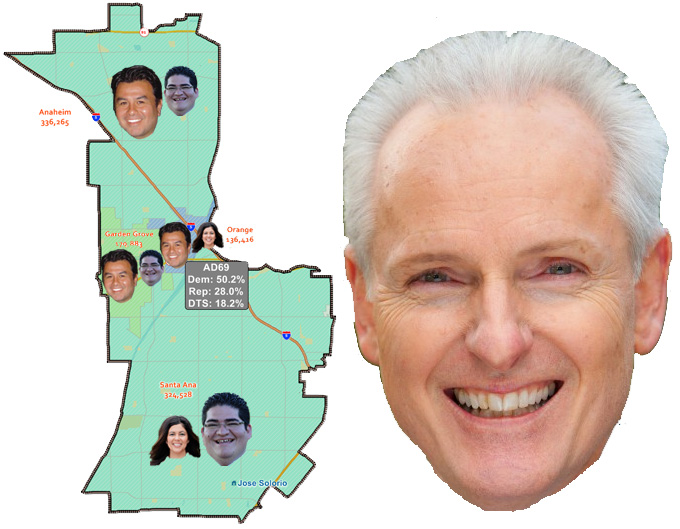
(Thanks to Matt Rexroad and Chandra Sharma at Meridian Pacific for the map, which I’ve cropped here and to which I have added graphics. Note that the population numbers on the map apply to each whole city, not just the portion of the city in AD-69. The bulk of Santa Ana and a sliver of Garden Grove are in AD-69 while a sliver of Santa Ana and the bulk of Garden Grove are in AD-72. A sliver of Orange is in AD-69 but the bulk of it is in AD-68. Anaheim is divided into nearly even thirds, with the western 1/3 in AD-65, the central 1/3 in AD-69, and the eastern 1/3 in AD-68.)
Daly was consistently first in each city while Barragan was consistently fifth. Moreno, Perez, and Martinez swapped around for the second, third, and fourth place positions. The humongous Daly head is indicative of his first place finish in all four cities; taking his head out of the individual cities allows us to more closely examine second and third place, which actually differed in the four cities. In each individual city, the candidate with the larger head came in second while the candidate with the smaller head came in third:
Here’s their vote totals broken down visually by city:

Since Daly came in first by such a large margin (indeed, Daly’s Santa Ana total nearly bested everyone else’s districtwide total) and Barragan fell to fifth by such a large margin (Daly’s Garden Grove total outpaced Barragan’s districtwide total), let’s take a closer look with just Moreno, Perez, and Martinez, who were closer together in the results:

It’s clear that without Anaheim, Perez would have made it into the top two and on to November, rather than Moreno. Moreno’s final vote total was 5,980 while Perez’s was 5,738. Without Anaheim, Moreno would have had 4,105 while Perez would have had 4,308. (Anaheim gave Moreno 1,875 votes and Perez 1,430 votes, a 445-vote margin). Perez lost districtwide to Moreno by 242 votes; without Anaheim, Moreno would have lost to Perez by 203 votes.
Anaheim was a crucial stronghold for Moreno, as he came in fourth in Santa Ana but second in Anaheim.
However, with so few cities in AD-69, and Santa Ana such a strong majority of that district (59% of registered voters in AD-69 live in Santa Ana, and 60% of ballots cast in AD-69 were from Santa Ana), it would be more useful to break this result down into regions smaller than cities. Luckily for this purpose, the City of Santa Ana has Council wards.

Here, the larger head came in first while the smaller head came in second:
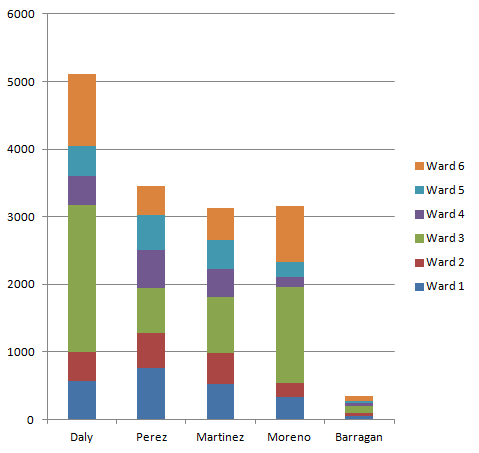
Despite the fact that Perez won four wards and Daly only won two, Daly actually won Santa Ana by a 10% margin. How? Well, 48% of registered voters in Santa Ana live in the two wards that Daly won: Wards 3 and 6. 49% of Santa Anans who voted in the AD-69 race live in Wards 3 and 6, so those two wards did not have disproportionate voter turnout – they just have a disproportionate share of the voters to begin with. A picture is worth a thousand words, so…

The overwhelming majority of Daly and Moreno’s votes in Santa Ana came from Wards 3 and 6, with 59% of Daly’s Santa Ana votes and 66% of Moreno’s Santa Ana votes coming from those two wards. By contrast, 29% of Perez’s Santa Ana votes and 38% of Martinez’s Santa Ana votes came from those two wards. Here’s each candidate’s vote totals broken down visually by ward:
Once again, due to Daly’s landslide first-place finish and Barragan’s distant fifth-place finish, let’s take a closer look with just Moreno, Perez, and Martinez, who were closer together in the results:

Perez’s vote totals were fairly evenly spread out across the wards, Martinez got a bump from Ward 3, but Moreno’s performance was very strong in Wards 3 and 6 and disastrous in Wards 2, 4, and 5.
Had Perez done a stronger push in Anaheim or a three-prong strategy in Anaheim, Santa Ana’s Ward 3, and Santa Ana’s Ward 6, there’d be a Democrat vs. Democrat intraparty battle in AD-69 in November between business-backed Tom Daly and union-backed Julio Perez.
Posted in 69th Assembly District | Tagged: Albert Ayala, Allan Mansoor, Francisco Barragan, Joe Dovinh, Jose Moreno, Julio Perez, Leslie Daigle, Long Pham, Michele Martinez, Paco Barragan, Robert Rush, Santa Ana Wards, Tom Daly, Travis Allen, Troy Edgar | 3 Comments »
Posted by Chris Nguyen on June 28, 2012

In a busy day at the Supreme Court, the justices issued their first opinion of the day. They ruled 6-3 in United States v. Alvarez that it is within a person’s First Amendment rights to lie about receiving the Medal of Honor, striking down the Stolen Valor Act as unconstitutional. Conservative Chief Justice John Roberts joined conservative swing voter Anthony Kennedy and the court’s four liberal justices: Elena Kagan, Sonia Sotomayor, Stephen Breyer, and Ruth Bader Ginsburg. The dissenters were conservative justices Samuel Alito, Clarence Thomas, and Antonin Scalia. Kennedy authored the opinion.

The second opinion of the day was the one everyone was waiting for: in a 5-4 decision in National Federation of Independent Businesses v. Sebelius, the U.S. Supreme Court upheld the entire health care law officially known as the Affordable Care Act but often called Obamacare. The individual mandate was held unconstitutional under the Commerce Clause but was upheld under the power to tax. The shocker: swing voter Anthony Kennedy was in the dissent. It was conservative Chief Justice John Roberts who not only voted with the four liberal justices but who wrote the opinion.
Posted in National | Tagged: Affordable Care Act, Anthony Kennedy, Antonin Scalia, Clarence Thomas, Elena Kagan, Obamacare, Ruth Bader Ginsburg, Samuel Alito, Sonia Sotomayor, Stephen Breyer, Stolen Valor Act | 4 Comments »
Posted by Chris Nguyen on June 27, 2012
Well, tomorrow is the last day for an initiative or referendum to qualify for the November ballot. With only one measure whose signatures are still pending verification (but that one appears to be falling far short of signature requirements), we now know which initiatives and referenda have made it to the November ballot.
Note the proposition numbers are tentative. The Legislature can still add measures to the ballot (or remove the Safe, Clean, and Reliable Drinking Water Supply Act of 2012 from the ballot), which would alter the numbering of the propositions. Here’s the list:
Proposition 30 – Safe, Clean, and Reliable Drinking Water Supply Act of 2012 (This was the water bond deal of 2009 authored by then-Senate Republican Leader Dave Cogdill that the Legislature put on the 2010 ballot before moving it to the 2012 ballot.)
Proposition 31 – Prohibits Political Contributions by Payroll Deduction. Prohibitions on Contributions to Candidates. Initiative Statute. (This is best known as Stop Special Interest Money Now.)
Proposition 32 – Changes Law to Allow Auto Insurance Companies to Set Prices Based on a Driver’s History of Insurance Coverage. Initiative Statute.
Proposition 33 – Death Penalty Repeal. Initiative Statute.
Proposition 34 – Human Trafficking. Penalties. Sex Offender Registration. Initiative Statute.
Proposition 35 – Three Strikes Law. Sentencing for Repeat Felony Offenders. Initiative Statute.
Proposition 36 – Genetically Engineered Foods. Mandatory Labeling. Initiative Statute.
Proposition 37 – Temporary Taxes to Fund Education. Guaranteed Local Public Safety Funding. Initiative Constitutional Amendment. (This is Governor Jerry Brown’s tax measure.)
Proposition 38 – Tax for Education and Early Childhood Programs. Initiative Statute. (This is Molly Munger’s tax measure.)
Proposition 39 – Tax Treatment for Multistate Businesses. Clean Energy and Energy Efficiency Funding. Initiative Statute.
Proposition 40 – State Budget. State and Local Government. Initiative Constitutional Amendment and Statute. (This is the two-year budget measure.)
Proposition 41 – Redistricting. State Senate Districts. Referendum.
Again, these numbers are tentative and can be changed if the Legislature yanks the first one off the ballot or adds other measures to the ballot.
These are the official titles from the Attorney General’s office from when these measures were cleared for circulation. It’s odd that the three crime-related measures were bunched together and the four fiscal measures were bunched together; that was just convenient from ballot qualification order.
More will come once we have a clearer look at the ballot after the deadline for the Legislature to place/remove measures for the November ballot.
(In the interest of full disclosure, Custom Campaigns has done some consulting work for Stop Special Interest Money Now, tentatively Proposition 31. For the record, we do not accept payments for blogging and require disclosures when a blogger has a potential conflict of interest in a blog post, unless it’s something really obvious, like a blogger blogging about their own candidacy for office.)
Posted in California | Tagged: Proposition 30, Proposition 31, Proposition 32, Proposition 33, Proposition 34, Proposition 35, Proposition 36, Proposition 37, Proposition 38, Proposition 39, Proposition 40, Proposition 41 | 2 Comments »
Posted by Chris Nguyen on June 26, 2012
Thomas A. Fuentes
(1948-2012)
Many of you may have read Frank Mickadeit’s column about the insensitive manner in which the South Orange County Community College District Board of Trustees dealt with the vacancy in the Trustee Area 6 seat that resulted from the untimely passing of Tom Fuentes. For those of you who haven’t read it, here are some excerpts:
Tom Fuentes had been dead just 72 hours before the long-fractured community college board on which he sat decided to appoint a replacement.
It seemed like a rather stunning affront to the Fuentes family…
Fuentes died very late on Friday, May 18. That Monday, the board majority decided over the objection of trustee David Lang to immediately solicit applicants for Fuentes’ seat, with the selection to be made at the June meeting.
…
Before the formal vote, Lang once more begged his colleagues to let voters decide the seat in November and called them out for making such a nakedly political decision. The seat will be on the ballot in November anyway, but by giving the seat to Wright now, he’ll have the power of incumbency. “A majority of the board is slanting the election in a trustee’s favor,” he said.
This allegation seemed to perturb board President Nancy Padberg, who tersely replied, “The board has decided and will move on.” When T. J. Fuentes told the board he was “very disturbed by the fact that the board had decided to appoint somebody before my father was even buried,” Padberg replied that, “it had to be processed timely.”
A number of people have expressed their consternation with the way the SOCCCD Trustees handled the entire process. Many have expressed the wish that the trustees had simply allowed the voters to fill the seat in the November election rather than fill the seat via appointment for the incumbency advantages Lang outlined above.
Last night, the trustees voted 5-1 to appoint James Wright, an outgoing dean at Saddleback College. I’m not aware of any objections to Wright himself, but the objections to the appointment have centered on two different rationales:
As it turns out, Education Code Section 5091(c)(1) lays out a procedure to invalidate the appointment (I’ve bolded the key portions):
If a provisional appointment is made within the 60-day period, the registered voters of the district may, within 30 days from the date of the appointment, petition for the conduct of a special election to fill the vacancy. A petition shall be deemed to bear a sufficient number of signatures if signed by at least the number of registered voters of the district equal to 11/2 percent of the number of registered voters of the district at the time of the last regular election for governing board members, or 25 registered voters, whichever is greater. However, in districts with registered voters of less than 2,000 persons, a petition shall be deemed to bear a sufficient number of signatures if signed by at least 5 percent of the number of registered voters of the district at the time of the last regular election for governing board members.
The last regular election for governing board members in SOCCCD was on November 2, 2010. According to the Statement of Vote for that election, there 549,192 registered voters in SOCCCD at that election. From that number, 1.5% is equal to 8,238 signatures.
If those signatures are collected, the appointment will be invalidated. Now some of you may notice the petition would create a special election. Indeed a special election would be an obscene waste of money since the seat expires in less than five months. As it turns out, Education Code Section 5093(c) deals with that:
If a special election pursuant to Section 5091 could be consolidated with the next regular election for governing board members, and the vacant position is scheduled to be filled at such regular election, there shall be no special election.
In other words, if the seat is up in a few months in the regular election anyway, the special election would be cancelled, and the voters would simply fill the seat at the regular election. So if a petition is launched immediately and gathers 8,238 valid signatures from registered voters within SOCCCD by July 25, the appointment would be invalidated, and the SOCCCD Trustee Area 6 seat would remain vacant until the voters filled it for the usual four-year term at the regular election in November – and no one would have the advantage of incumbency in that regular election in November.
With the Fuentes family’s deep political ties across Orange County, will someone step up in the next few days to launch a petition drive to invalidate the appointment to the SOCCCD Trustee Area 6 seat, allowing the voters to pick Fuentes’s successor in November?
Posted in South Orange County Community College District | Tagged: appointment, David Lang, Frank Mickadeit, James Wright, Jolene Fuentes, Nancy Padberg, petition, special election, Thomas A. "T.J." Fuentes, Tom Fuentes | 4 Comments »
Posted by Chris Nguyen on June 25, 2012
By now, you’ve likely heard about the U.S. Supreme Court’s ruling in Arizona v. United States which decided the constitutionality of Arizona’s S.B. 1070. Legal experts often say that judicial ideology is hard to measure, but for the sake of brevity, I’ll use the layman’s categorization of which justices are conservatives and liberals.
Liberal justice Elena Kagan recused herself since she was Solicitor General at the time the Obama Administration decided to challenge S.B. 1070.
A lot of news coverage has left out how the justices voted, so here’s my quickie guide (my far-too-short analysis of the practical implications follows the guide):

The Court voted unanimously to uphold Section 2(B):
For any lawful contact made by a law enforcement official or agency of this state or a county, city, town or other political subdivision of this state where reasonable suspicion exists that the person is an alien who is unlawfully present in the United States, a reasonable attempt shall be made, when practicable, to determine the immigration status of the person. The person’s immigration status shall be verified with the federal government pursuant to 8 United States Code Section 1373(c).
In other words, law enforcement officers may determine the immigration status of any person “where reasonable suspicion exists” after the officers make a stop, detention, or arrest.

In a 6-2 decision, the Court struck down Section 3, which is a page and a half long (way too long to reproduce here, but accessible here). In essence, that section made it misdemeanor trespassing to be illegally in Arizona.
In this portion, conservatives Samuel Alito and John Roberts joined with conservative swing voter Anthony Kennedy and liberals Ruth Bader Ginsburg, Stephen Breyer, and Sonia Sotomayor to strike down that portion of the S.B. 1070 as unconstitutional. Conservatives Clarence Thomas and Antonin Scalia voted to uphold that portion of S.B. 1070.

In a 5-3 decision, the Court struck down Section 5(C):
It is unlawful for a person who is unlawfully present in the United States and who is an unauthorized alien to knowingly apply for work, solicit work in a public place or perform work as an employee or independent contractor in this state.
In other words, that section made it a misdemeanor to work or seek work in the United States without a green card, a visa, or U.S. citizenship.
Conservative Chief Justice Roberts joined with conservative swing voter Kennedy and liberals Ginsburg, Breyer, and Sotomayor to strike down Section 5(C) of S.B. 1070 as unconstitutional. Conservatives Alito, Thomas, and Scalia voted to uphold that section of S.B. 1070.

In a 5-3 decision, the Court struck down Section 6, which is nearly 4 pages long (way, way too long to reproduce here, but can be accessed here). In essence, that section allows a law enforcement officer to arrest someone without a warrant for “any public offense” that makes the person deportable.
As with Section 5(C), conservative Chief Justice Roberts joined with conservative swing voter Kennedy and liberals Ginsburg, Breyer, and Sotomayor to strike down Section 6 of S.B. 1070 as unconstitutional. Conservatives Alito, Thomas, and Scalia voted to uphold that section of S.B. 1070.
Practical Implications
Sections 2(B) was the most potent clause of S.B. 1070, followed by Section 6 while Sections 3 and 5(C) were less significant. Sections 3 and 5(C) dealt with creating specific misdemeanors, but Sections 2(B) and 6 gave Arizona police and sheriff’s vast powers of enforcement. Section 6 allows law enforcement to arrest for any deportable offense even without a judicial order. Section 2(B) allows law enforcement to demand proof of legal status from anyone they stop (if they’ve stopped them for another reason).
The Court’s ruling still allows Arizona law enforcement to demand proof of legal status, yet doesn’t allow them to enforce their two misdemeanors or make an arrest for a deportable offense without a judicial order.
It was weird enough that Roberts joined Kennedy and the liberals on the entire ruling and Alito joined them on 1 of the 3 non-unanimous portions of the decision. However, it’s truly weird that the most potent portion of S.B. 1070 was upheld while the other portions were struck down. While this may make legal sense, it has really odd practical implications.
Posted in National | Tagged: Anthony Kennedy, Antonin Scalia, Arizona S.B. 1070, Arizona v. United States, Clarence Thomas, Elena Kagan, Jan Brewer, John Roberts, Ruth Bader Ginsburg, Samuel Alito, Sonia Sotomayor, Stephen Breyer | 1 Comment »
Posted by Former Blogger Chris Emami on June 25, 2012
In a story that looks like it could have come from The Maury Povich Show, a conflict appears to be brewing between the Brea Police Department and the Orange County Sheriffs Department.
H/T to reader Allen Wilson who sent me this flyer that is apparently being passed around at supermarkets in the City of Brea:
 Clearly the Orange County Sheriffs Department already has the upper hand with the decision being made by the Yorba Linda City Council to give them the contract. This is actually a wise tactical move to ensure that enough pressure is applied in Brea to stamp out any threat to the contract.
Brea Councilmembers are obviously going to be worried about their own city in an election year and will unlikely push the issue further for fear of losing votes in November. The political season is upon us and decisions are often weighed carefully by consultants on what impact it will have on voters.
With the Brea PD going up against the OCSD though it should make for an interesting November election both on Yorba Linda and Brea.
Posted in Brea, Yorba Linda | 1 Comment »
Posted by Newsletter Reprint on June 24, 2012
This came over the wire from Atlas PAC on Friday…
Reception for Orange City Councilman Jon Dumitru
Posted in California, Fundraising, Orange | Tagged: Atlas PAC, Carl DeMaio, Jon Dumitru | Leave a Comment »
Posted by Newsletter Reprint on June 24, 2012
This came over the wire from Supervisor Bill Campbell’s office on Friday…
Read the rest of this entry »
Posted in 3rd Supervisorial District | Tagged: Bart Bartlett, Bill Campbell, Bill Vanderwerff, Cindy Quon, Fran Klovstad, Gary Blankenship, Howard Thomas, Jacqueline Cole, Jim Palmer, John Arnau, Kathy Lucas, Laura Cunningham, Laura Thomas, Linda Strickland, Lisa Ohlund, Matt Monzon, Mitch Chernes, Orange County Islamic Foundation, Peter Jacklin, Richard Bell, Sandra Hutchens, Sue Phillip | Leave a Comment »


