OC Political

A right-of-center blog covering local, statewide, and national politics

Author Archive

Will the Santa Ana Term Limits Lawsuit Be Dismissed by the Court?

Posted by Chris Nguyen on July 11, 2012

 You may have read the post by Emami yesterday or the Voice of OC article from Monday about the lawsuit filed by Santa Ana Parks and Recreation Commissioner Max Madrid, a staffer for State Senator Lou Correa (D-Santa Ana), to try to get Councilwoman Claudia Alvarez (D-Santa Ana) ruled eligible for another term despite her serving the maximum number of terms permissible under Santa Ana Charter Section 401 on the basis that when the term limit was changed from two terms to three terms was changed by Measure D in 2008 that the clock restarted for Alvarez since the measure didn’t say that terms prior to 2008 counted under Section 401.  Madrid is represented by Rancho Santa Margarita City Councilman Steve Baric, who is also Vice Chairman of the California Republican Party.

This morning, Chris Prevatt at The Liberal OC noted:

First, Madrid is not the party harmed by the determination by two legal opinions sought by the Council which are the foundation of Huizar’s statement in April that Alvarez is ineligible to serve past the end of her current third term. The only party harmed if Alvarez is denied access to nomination papers is Alvarez, not a third party like Madrid.

Looking at a copy of the suit, I suspect Prevatt is right, and the judge may dismiss the suit because Madrid indeed has insufficient standing to bring the suit.  As justification of Madrid’s standing, the suit states:

Petitioner and Plaintiff MAX MADRID (“Petitioner”) is, and at all relevant times hereto was, a resident voter and taxpayer of the City of SANTA ANA, (“City”), California.  Petitioner is currently registered to vote in the City and has paid property and/or sales taxes to the City within the past twelve months.  Plaintiff, as a municipal taxpayer seeking to avoid the waste of municipal assets, falls into the category of a type of claimant long recognized to possess a sufficiently intense interest in his claim to establish his “standing” to enter the courtroom.  Because a successful attack on wrongful municipal spending or disposition of assets in all likelihood may reduce the municipal taxpayer’s burden of meeting the expenses of government, courts do not doubt that a municipal taxpayer will effectively present his claim.  “[T]axpayers have a sufficiently personal interest in the illegal expenditure of funds by [municipal] officials to become dedicated adversaries.” (Harman v. City and County of San Francisco (1972) 7 Cal.3d 150.) In this capacity, Petitioner has standing to bring this action pursuant Code of Civil Procedure section 526(a) and case law.  Additionally, as a registered voter he has standing to challenge any implementation or application of the City Charter and ordinances.

I don’t see how preventing the City from stopping a Councilmember from running for another term prevents “the illegal expenditure of funds” by the City or “wrongful municipal spending” by Santa Ana.   The suit offers no justification for why registered voters have “standing to challenge any implementation or application of the City Charter and ordinances,” particularly since this one merely deals with the eligibility of a candidate.

California Code of Civil Procedure Section 526(a) states:

526. (a) An injunction may be granted in the following cases:
(1) When it appears by the complaint that the plaintiff is entitled to the relief demanded, and the relief, or any part hereof, consists in restraining the commission or continuance of the act complained of, either for a limited period or perpetually.
(2) When it appears by the complaint or affidavits that the commission or continuance of some act during the litigation would produce waste, or great or irreparable injury, to a party to the action.
(3) When it appears, during the litigation, that a party to the action is doing, or threatens, or is about to do, or is procuring or suffering to be done, some act in violation of the rights of another party to the action respecting the subject of the action, and tending to render the judgment ineffectual.
(4) When pecuniary compensation would not afford adequate relief.
(5) Where it would be extremely difficult to ascertain the amount of compensation which would afford adequate relief.
(6) Where the restraint is necessary to prevent a multiplicity of judicial proceedings.
(7) Where the obligation arises from a trust.

I don’t see Alvarez’s inability to run for Council as harming Madrid in any of the seven ways above.

Now, if the City Clerk did allow Alvarez to run, then a person could bring suit to stop her on the argument that they could suffer harm by having an ineligible person on the ballot, as that could a) harm their own run for Council or b) be the illegal expenditure of funds cited in Madrid’s suit.

Relief can only be granted to Alvarez.  The only person who can be harmed by preventing Alvarez from running is Alvarez.  Madrid doesn’t have standing to bring the suit, and consequently, I suspect the Court will dismiss the case because of Madrid’s insufficient standing.  If Alvarez wants to be ruled eligible to run for a fourth term, she is going to have to file suit herself, as only she has suffered enough harm to gain sufficient standing in court.

Posted in Santa Ana | Tagged: , , | 6 Comments »

Judge Rules Against Munger, Brown’s Ballot Measure Arrangement Bill Stands, Propositions Numbered at Last

Posted by Chris Nguyen on July 10, 2012

As I wrote about here, Molly Munger filed suit to stop AB 1499 from taking effect. AB 1499, which Governor Jerry Brown signed into law on June 27, changed the order that ballot measures appear on the ballot.

Sacramento Superior Court Judge Timothy M. Frawley rejected Munger’s suit entirely.

Consequently, his temporary restraining order preventing the Secretary of State’s office from numbering the ballot propositions has ended.

The Secretary of State’s office has now numbered the ballot measures, so these are the propositions for the statewide ballot for November:

Proposition 30 – Temporary Taxes to Fund Education. Guaranteed Local Public Safety Funding. Initiative Constitutional Amendment. (This is Governor Jerry Brown’s tax measure.)

Proposition 31 – State Budget. State and Local Government. Initiative Constitutional Amendment and Statute. (This is the two-year budget measure.)

Proposition 32 – Prohibits Political Contributions by Payroll Deduction. Prohibitions on Contributions to Candidates. Initiative Statute. (This is best known as Stop Special Interest Money Now.)

Proposition 33 – Changes Law to Allow Auto Insurance Companies to Set Prices Based on a Driver’s History of Insurance Coverage. Initiative Statute.

Proposition 34 – Death Penalty Repeal. Initiative Statute.

Proposition 35 – Human Trafficking. Penalties. Sex Offender Registration. Initiative Statute.

Proposition 36 – Three Strikes Law. Sentencing for Repeat Felony Offenders. Initiative Statute.

Proposition 37 – Genetically Engineered Foods. Mandatory Labeling. Initiative Statute.

Proposition 38 – Tax for Education and Early Childhood Programs. Initiative Statute. (This is Molly Munger’s tax measure.)

Proposition 39 – Tax Treatment for Multistate Businesses. Clean Energy and Energy Efficiency Funding. Initiative Statute. (This is Tom Steyer’s tax measure.)

Proposition 40 – Redistricting. State Senate Districts. Referendum.

Arguments for and against these ballot propositions are due to the Secretary of State by 5:00 PM today.  In case of multiple arguments being submitted, the Secretary of State’s office is required by law to give priority to the official proponents, followed by bona fide associations of citizens, and then individuals.

Rebuttal arguments are due by 5:00 PM on Thursday, July 19.  Litigation regarding these statements must be filed by 5:00 PM on Monday, August 13.

(In the interest of full disclosure, Custom Campaigns has done some consulting work for Stop Special Interest Money Now, now known as Proposition 32.  For the record, we do not accept payments for blogging and require disclosures when a blogger has a potential conflict of interest in a blog post, unless it’s something really obvious, like a blogger blogging about their own candidacy for office.)

Posted in California | Tagged: , , , , , , , , , , , , , | 1 Comment »

Field Poll: Brown Tax Leads, Even Split on Munger & Steyer Taxes, High-Speed Rail Decreases Support for Brown Tax

Posted by Chris Nguyen on July 9, 2012

Since you’re reading this post, you obviously passed the test we posted on Friday to avert being knocked off the Internet.

Three tax measures have qualified for the November ballot, sponsored by Governor Jerry Brown, multimillionaire heiress attorney Molly Munger, and billionaire businessman Tom Steyer, respectively.

Ballot Measure Proponents Jerry Brown, Molly Munger, and Tom Steyer

Munger Sues State

The battle between Munger and Brown on ballot measure numbering has a hearing scheduled today at 9:00 AM. (Munger asked the court to delay the hearing for another nine days, stating the Los Angeles County Registrar of Voters had refused to supply documents or completely answered questions, but was apparently unsuccessful in getting the delay.)  For more details on the suit, read my post from last Monday (note that on Thursday, the Legislature approved legislation moving the water bond from the 2012 ballot to the 2014 ballot; the water bond would have been Proposition 30 regardless of Munger’s lawsuit, so when reading that post, just remove Proposition 30 and subtract one from the numbering of all the other measures; other than that, everything in the post is still current information).

If Munger prevails, her ballot measure will be Proposition 36 rather than Proposition 38, Brown’s ballot measure will be Proposition 37 rather than Proposition 30, and Steyer’s will be Proposition 38 rather than Proposition 39.  In other words, if Munger prevails, the ballot order will be six other measures, the Munger measure, the Brown measure, the Steyer measure, and two other measures.  If Brown prevails, the ballot order will be the Brown measure, seven other measures, the Munger measure, the Steyer measure, and the Senate redistricting referendum.

Brown’s Income and Sales Tax Increase Measure Leads, But is Threatened by High-Speed Rail

The latest Field Poll finds Governor Jerry Brown’s income and sales tax increase ballot measure leads 54%-38%, with 8% undecided.  (The poll found a similar result in May, with the measure leading 52%-35%, with 13% undecided.)   Brown’s tax increase ballot measure leads among every demographic and geographic group, as well as liberals, moderates, Democrats, and independents.  Only conservatives and Republicans oppose the measure.  However, not all is rosy for the Brown tax increase measure…

21% of the measure’s supporters indicated that they would be less inclined to support the Brown tax increase if the high-speed rail funding bill was approved.  Conversely, only 5% of the measure’s opponents indicated that they would be more inclined to support the Brown tax increase if the high-speed rail funding bill was approved.

(The poll was completed shortly before the Senate passed the high-speed rail funding bill 21-16 on Friday and the Assembly passed the bill 51-27 on Thursday.  Brown is expected to sign the bill this week.)

The high-speed rail bill’s approval may very well endanger Brown’s tax increase initiative.  Ballot measures typically lose support as campaigns wear on, and the high-speed rail may send support for Brown’s tax increase measure under 50%, making it that much more difficult to pass once the campaign season begins in the fall.

Voters Evenly Split on Munger Income Tax Increase Measure

Molly Munger’s income tax increase ballot measure has voters perfectly split, with 46% supporting it and 46% opposing it.

Republicans oppose the Munger income tax increase, Democrats support it, and independents are evenly split.  Conservatives and moderates oppose it while liberals support it.  Men oppose it while women support it.  Whites oppose it, Latinos support it, and other ethnic groups were split.

Voters under 40 support the Munger income tax increase measure while voters over 40 oppose it.  Union households support it while non-union households were split.  People making less than $40,000 support it while voters making more than $40,000 oppose it.

As expected, San Francisco Bay Area voters support the Munger income tax increase measure while other Northern Californians oppose it.  Strangely, Los Angeles County voters are evenly split on the measure while other Southern Californians were supportive, upending the typical result of LA County being less tax-averse than other Southern Californians (in this same poll, on the Brown and Steyer measures, the more-expected result of LA County being less tax averse than the rest of Southern California occurred).

Voters Evenly Split on Steyer Singles Sales Factor for Business Income Tax Calculation Measure

Tom Steyer’s measure requiring the singles sales factor for business income tax calculation has voters effectively split, with 44% supporting it and 43% opposing it.

Conservatives and Republicans oppose the Steyer single sales factor measure while independents, moderates, Democrats, and liberals support it.  While both genders were split within the margin of error, men were more likely to oppose while women were more likely to support.  Whites oppose the measure, Latinos support it, and other ethnic groups were evenly split.

Voters under 40 support the Steyer singles sales factor measure, voters over 65 oppose it, while middle-aged voters were even split.  Union households were supportive while non-union households were evenly split.  Voters making making $40,000-$99,999 support the measure while those making more than $100,000 oppose the measure.  Oddly, those making less than $40,000 were evenly split.

The San Francisco Bay Area and Los Angeles County support the Steyer single sales factor measure while the rest of Northern and Southern California oppose it.

Will the LA County Measure R Sales Tax Extension Accidentally Kill All the Tax Measures?

In 2008, LA County voters approved Measure R, a 0.5% sales tax increase to fund transportation projects that took effect July 1, 2009, and expires 30 years later in 2039.  Inexplicably, the LA Metropolitan Transportation Authority voted to place an extension of Measure R on the November 2012 ballot to add 30 years to the 0.5% sales tax increase making it expire in 2069.

Just four years into a thirty-year tax, voters are being asked to make it a sixty-year tax.  If approved, nearly all people who vote on this ballot measure will be dead by the time the tax expires.

It seems strategically odd to ask for an extension so soon after the initial passage.  It would have seemed more strategically sound to wait until 2030 or so when Measure R was nearing expiration.

The placement of the Measure R extension on the November ballot means LA County voters will be faced with four tax measures on their ballot.  Voter tax fatigue will take its toll in LA County.

Why does LA County tax fatigue matter to the rest of the state?  Well, 1/4 of all Californians live in Los Angeles County.

Look at Prop 29: it failed by 0.6%.  The San Francisco Bay Area went overwhelmingly for it.  Most of Northern and Southern California went overwhelmingly against it.  Los Angeles County narrowly went against Prop 29.

This Measure R extension may be the inadvertent death knell of the tax-related statewide ballot measures in November.

LA County support is pivotal for any tax measure hoping to pass in California.

What the Three State Ballot Measures Would Do

For those of you who are wondering what the three state ballot measures would do…

Brown’s measure (likely Proposition 30 or Proposition 37, it is officially titled, “Temporary Taxes to Fund Education. Guaranteed Local Public Safety Funding. Initiative Constitutional Amendment. “) would increase personal income taxes for amounts above $250,000 per year for seven years and raise the state sales tax by 0.25% for four years. Specifically, income taxes on amounts:

  • between $250,000-$300,000 would increase by 1% to 10.3%
  • between $300,000-$500,000 would increase by 2% to 11.3%
  • above $500,000 would increase by 3% to 12.3%

Sales taxes in OC would climb to 8%, except in La Habra, where it would go to 8.5%. LA County sales tax would go up to 9%.

For seven years, 89% of the tax money is allocated to K-12 schools with 11% to community colleges. On a permanent basis, 1.0625% sales tax would be permanently removed from the Prop 98 education funding formula to fund local public safety realignment programs.

Click here for the Legislative Analyst Office’s official fiscal analysis of the Brown measure.

Munger’s measure (likely Proposition 36 or Proposition 38, it is officially titled, “Tax for Education and Early Childhood Programs. Initiative Statute.”) would increase personal income taxes on nearly all Californians for twelve years.  Specifically, for individuals who are not heads of households, income taxes on amounts:

  • between $7,316-$17,346 would increase by 0.4% to 2.4%
  • between $17,346-$27,377 would increase by 0.7% to 4.7%
  • between $27,377-$38,004 would increase by 1.1% to 7.1%
  • between $38,004-$48,029 would increase by 1.4% to 9.4%
  • between $48,029-$100,000 would increase by 1.6% to 10.9%
  • between $100,000-$250,000 would increase by 1.8% to 11.1%
  • between $250,000-$500,000 would increase by 1.9% to 11.2%
  • between $500,000-$1,000,000 would increase by 2.0% to 11.3%
  • between $1,000,000-$2,500,000 would increase by 2.1% to 11.4%
  • above $2,500,000 would increase by 2.2% to 11.5%

For heads of households, income taxes on amounts:

  • between $14,642-$34,692 would increase by 0.4% to 2.4%
  • between $34,692-$44,721 would increase by 0.7% to 4.7%
  • between $44,721-$55,348 would increase by 1.1% to 7.1%
  • between $55,348-$65,376 would increase by 1.4% to 9.4%
  • between $65,376-$136,118 would increase by 1.6% to 10.9%
  • between $136,118-$340,294 would increase by 1.8% to 11.1%
  • between $340,294-$680,589 would increase by 1.9% to 11.2%
  • between $680,589-$1,361,178 would increase by 2.0% to 11.3%
  • between $1,361,178-$3,402,944 would increase by 2.1% to 11.4%
  • over $3,402,944 would increase by 2.2% to 11.5%

For the first four years, 60% of the tax money is allocated to K-12 schools, 10% to early childhood programs, and 30% to repaying state debt. For the remaining eight years, 85% of the tax money is allocated to K-12 schools and 15% to early childhood programs.

Click here for the Legislative Analyst Office’s official fiscal analysis of the Munger measure.

Steyer’s measure (likely Proposition 38 or Proposition 39, it is officially titled, “Tax Treatment for Multistate Businesses. Clean Energy and Energy Efficiency Funding. Initiative Statute.”) would permanently impose the single sales factor calculation on income taxes for multistate businesses.

For five years, $550,000,000 would be allocated from the state General Fund into the “Clean Energy Job Creation Fund,” which would be used for energy efficiency retrofits and alternative energy installations in government buildings, local government energy retrofit financial assistance programs, and job training and workforce development programs.

Click here for the Legislative Analyst Office’s official fiscal analysis of the Steyer measure.

Posted in California | Tagged: , , , , , , , , , , , , , , , | Leave a Comment »

Malware to Knock 277,000 People Off Internet on Monday: Make Sure You’re Not One of Them

Posted by Chris Nguyen on July 6, 2012

So this isn’t one of our normal political posts, but it’s important for all our readers.  Click here to test your computer (the test is instantaneous and takes literally one second).  Make sure you’re not one of the 277,000 Internet users worldwide who will lose Internet access on Monday, due to a malware infection.

From CNN:

Hundreds of thousands of Internet users whose computers are infected with a particularly nasty virus will be unable to access the Web starting on Monday.

The Federal Bureau of Investigation will shut down Internet servers that it temporarily set up to support those affected by malicious software, called DNSChanger. Turning off those servers will knock all those still infected offline.

Over the past five years, a group of six Estonian cybercriminals infected about 4 million computers around the world with DNSChanger. The malware redirected infected users’ Web searches to spoofed sites with malicious advertisements.

From the LA Times:

The problem is a result of a large online advertising scam that took over more than 4 million computers around the world.

When the FBI went in to shut down the scheme, the agency realized that turning off the malicious servers would cause infected computers to lose access to the Internet. So the FBI set up two other servers, which have been connecting infected users to the Internet, but they will be shut down on July 9 at 12:01 a.m. EDT.

As a result, 277,000 computer users worldwide as well as about 50 Fortune 500 companies could be affected by the shutdown, according to a report by the Associated Press.

Run that test from the beginning of the article.  Here’s the link again.  If you’ve been infected, go here for a guide on how to fix your computer.

Posted in International | Tagged: , , | 4 Comments »

What’s Next for Bustamante and What Happens to His Council Seat

Posted by Chris Nguyen on July 3, 2012

Carlos Bustamante’s Mugshot

Clearly, the biggest news in OC politics this week is the arrest of Councilman Carlos Bustamante (R-Santa Ana) on twelve felony counts, including six counts of false imprisonment, three counts of assault with the intent to commit a sexual offense, one count of stalking, one count of attempted sexual battery by restraint, and one count of grand theft by false pretense.  Additionally, there were four misdemeanor counts and a sentencing enhancement added.

These charges are in connection with his time as Director of Administrative Services for OC Public Works.

Listed with the occupation of consultant on his booking record, Bustamante was released on $100,000 bail last night at 11:25 PM.

District Attorney Tony Rackauckas will be holding a press conference at 9:30 AM this morning to discuss the Bustamante case in greater detail.

Gustavo Arrellano at OC Weekly reports that Bustamante has a court appearance on Thursday.

Whatever is the end result of his felony prosecution will be between him, his lawyers, and the DA’s office, and possibly, a jury.

However, as Bustamante is a councilman, we will now take a look at the political implications of his arrest.  He is almost assuredly not going to run for a third term in November.  Even if he does run, he will lose, unless he gets a very extreme split of the anti-incumbent vote (remember, Judge Ronald Kline still received 35% of the vote after being publicly accused of child molestation and being indicted for possessing over 100 images of child pornography).

Assuming Bustamante does the rational thing and does not seek re-election, what happens to Bustamante’s seat in the meantime?  Will it go vacant?  According to Government Code Section 1770, there are 12 ways in which a city councilmember’s seat can become vacant:

An office becomes vacant on the happening of any of the following events before the expiration of the term:

(a) The death of the incumbent.

(b) An adjudication pursuant to a quo warranto proceeding declaring that the incumbent is physically or mentally incapacitated due to disease, illness, or accident and that there is reasonable cause to believe that the incumbent will not be able to perform the duties of his or her office for the remainder of his or her term. This subdivision shall not apply to offices created by the California Constitution nor to federal or state legislators.

(c) His or her resignation.

(d) His or her removal from office.

(e) His or her ceasing to be an inhabitant of the state, or if the office be local and one for which local residence is required by law, of the district, county, or city for which the officer was chosen or appointed, or within which the duties of his or her office are required to be discharged.

(f) His or her absence from the state without the permission required by law beyond the period allowed by law.

(g) His or her ceasing to discharge the duties of his or her office for the period of three consecutive months, except when prevented by sickness, or when absent from the state with the permission required by law.

(h) His or her conviction of a felony or of any offense involving a violation of his or her official duties. An officer shall be deemed to have been convicted under this subdivision when trial court judgment is entered. For purposes of this subdivision, “trial court judgment” means a judgment by the trial court either sentencing the officer or otherwise upholding and implementing the plea, verdict, or finding.

(i) His or her refusal or neglect to file his or her required oath or bond within the time prescribed.

(j) The decision of a competent tribunal declaring void his or her election or appointment.

(k) The making of an order vacating his or her office or declaring the office vacant when the officer fails to furnish an additional or supplemental bond.

(l) His or her commitment to a hospital or sanitarium by a court of competent jurisdiction as a drug addict, dipsomaniac, inebriate, or stimulant addict; but in that event the office shall not be deemed vacant until the order of commitment has become final.

He’s alive (a), he’s not incapacitated (b), he filed his oath years ago (i), his election was valid (j), his office does not require an additional bond (k), and he has not been committed to a hospital or sanitarium (l).

If (e) or (f) apply, then he will be a fugitive from the law, as I’m pretty sure he’s not allowed to leave the jurisdiction.

He cannot be recalled (d), as Elections Code Section 11007(c) prohibits recalls when there’s less than six months left in an elected official’s term.

That leaves us with (c), (g), and (h).  However, (g) is overridden by the stricter Santa Ana City Charter Section 403:

If a member of the City Council absents himself from all regular meetings of the City Council for a period of sixty (60) days consecutively from and after the last regular City Council meeting attended by such member, unless by permission of the City Council expressed in its official minutes, his office shall become vacant and shall be so declared by the City Council.

So that leaves us with California Government Code Section 1770(c) and Section 1770(h), along with Santa Ana City Charter Section 403:

  • Now, (c) is the most straightforward: Bustamante can resign, or he can hang on to office as the legal proceedings on his charges move forward.
  • Subdivision (h) depends on the outcome of his criminal proceedings: if he pleads guilty to at least one of the felonies or if he’s convicted, then (h) will occur.
  • With City Section 403, he’s already missed the July 2 Council meeting because he was arrested on his way to that meeting.  If he misses the July 16, August 6, and August 20 meetings, then he will have absented himself from council meetings for sixty days.  The council could then declare his seat vacant at the September 3 meeting, though there’d only be two months until the election to fill his seat for the normal four-year term.  If he shows up to just one of those three meetings, then Section 403 will be rendered inoperative.

The other part of Section 403 of the Santa Ana City Charter reads:

In the event of a vacancy in the City Council, for whatever cause, the City Council shall declare the office vacant and fill the same by appointment. In each case the person so appointed shall hold office until the next general municipal election and until his successor is elected and qualified for the remainder of an unexpired term. Such appointee must, at the time of his appointment and continuously for one (1) year prior thereto, have been and be a resident of the ward from which his predecessor was elected. If the City Council shall fail to fill a vacancy by appointment within thirty (30) days after such an office shall have become vacant, it shall forthwith cause an election to be held to fill such vacancy.

In essence, if the Council fails to make an appointment within 30 days of the vacancy, then they will trigger an election.  I would note Bustamante’s term expires five months from today.  Filing for most offices closes on August 10, but for races where an eligible incumbent chooses not to file (e.g. Bustamante), the deadline is extended to August 15.

If Bustamante resigns before August 15, it’s still possible for the Santa Ana City Council to appoint someone to Bustamante’s seat in time for candidate filing.  If he resigns after that, they could appoint a caretaker or one of the candidates but that person would not have the incumbent designation on the ballot.

Posted in Orange County, Orange County District Attorney's Office, Santa Ana | Tagged: , , , | 6 Comments »

Santa Ana Councilman Bustamante Arrested for 12 Felonies, Including Assault, Attempted Sexual Battery, False Imprisonment

Posted by Chris Nguyen on July 2, 2012

Carlos Bustamante

The Office of District Attorney Tony Rackauckas has issued a media advisory indicating that Santa Ana City Councilman Carlos Bustamante (the former Director of Administrative Services for OC Public Works) has been arrested for twelve felonies: grand theft by false pretense, stalking, attempted sexual battery by restraint, three counts of assault with the intent to commit a sexual offense, and six counts of false imprisonment.  The arrest also included four misdemeanors and a sentencing enhancement, according to the media advisory:

Orange County District Attorney
Media Advisory

WHO: Orange County District Attorney (OCDA) Tony Rackauckas

WHAT: Will hold a press conference to discuss the criminal charges against Santa Ana City Councilman and former administration manager for Orange County Public Works Carlos Bustamante.

Bustamante was arrested today, Monday, July 2, 2012, at 4:30 p.m. by OCDA Investigators on six felony counts of false imprisonment, three felony counts of assault with the intent to commit a sexual offense, one felony count each of stalking, attempted sexual battery by restraint, and grand theft by false pretense, and one misdemeanor count each of battery, assault, sexual battery, and attempted sexual battery with a sentencing enhancement allegation for committing the offenses as a result of sexual compulsion and for the purpose of sexual gratification.

WHEN: Tomorrow, Tuesday, July 3, 2012, at 9:30 a.m.

            Media will be permitted to set up beginning at 8:00 a.m.

WHERE: Law Library of the OCDA’s Office, 401 Civic Center Drive W., Santa Ana

Here’s the coverage from the local news media:

Here’s The Liberal OC‘s post on the Bustamante arrest.

The Associated Press has the story too, as shown here in the San Jose Mercury-News.

Elected in 2004, Bustamante is the Santa Ana Council’s sole Republican.  He is eligible to run for a third term, but this arrest makes that  campaign extremely unlikely.

Posted in Orange County, Orange County District Attorney's Office, Santa Ana | Tagged: , | 7 Comments »

Molly Munger Files Suit Over Ballot Measure Placement; Judge Halts Numbering Until 7/9

Posted by Chris Nguyen on July 2, 2012

On June 27, the State Senate passed AB 1499 on a near-party-line 24-15 vote (Democrat Joe Simitian of Palo Alto joined the Republicans in voting against the bill, with Republican Sharon Runner of the Antelope Valley not voting), the State Assembly passed the bill on a party-line 50-24 vote (with three Republicans, two Democrats, and one Republican-turned-independent Nathan Fletcher not voting), and the Governor signed the bill into law.

So what exactly does AB 1499 do?  It changes the order that ballot measures appear on the ballot.  Because this bill was a budget trailer bill, it has already become law, rather than waiting until January 1, like the average bill.

Under the law as it existed on June 26, this was the order of how measures appeared on the ballot:

  1. Bond measures proposed by the Legislature
  2. Constitutional amendments proposed by the Legislature
  3. Other measures proposed by the Legislature
  4. Initiative measures
  5. Referenda

However, AB 1499, which is now the law of the land, changed the order thusly:

  1. Bond measures (regardless of whether they were put there by the Legislature or initiative)
  2. Constitutional amendments (regardless of whether they were put there by the Legislature or initiative)
  3. Measures proposed by the Legislature that aren’t bonds or constitutional amendments
  4. Initiative measures that aren’t bonds or constitutional amendments
  5. Referenda

Molly Munger (a Democrat and the sister of Republican Charles Munger, Jr.) has filed suit to stop AB 1499 from affecting the November 2012 election.

Why is she doing this?

Well, take a look at my previous post (which went online just hours before AB 1499 made its way through the Legislature) that noted the likely order of the ballot measures.  Then, take a look at what the order will be if AB 1499 is allowed to move forward unfettered:

Proposition 30 – Safe, Clean, and Reliable Drinking Water Supply Act of 2012 (This was the water bond deal of 2009 authored by then-Senate Republican Leader Dave Cogdill that the Legislature put on the 2010 ballot before moving it to the 2012 ballot.)

Proposition 31 – Temporary Taxes to Fund Education. Guaranteed Local Public Safety Funding. Initiative Constitutional Amendment. (This is Governor Jerry Brown’s tax measure.)

Proposition 32 – State Budget. State and Local Government. Initiative Constitutional Amendment and Statute. (This is the two-year budget measure.)

Proposition 33 – Prohibits Political Contributions by Payroll Deduction. Prohibitions on Contributions to Candidates. Initiative Statute. (This is best known as Stop Special Interest Money Now.)

Proposition 34 – Changes Law to Allow Auto Insurance Companies to Set Prices Based on a Driver’s History of Insurance Coverage. Initiative Statute.

Proposition 35 – Death Penalty Repeal. Initiative Statute.

Proposition 36 – Human Trafficking. Penalties. Sex Offender Registration. Initiative Statute.

Proposition 37 – Three Strikes Law. Sentencing for Repeat Felony Offenders. Initiative Statute.

Proposition 38 – Genetically Engineered Foods. Mandatory Labeling. Initiative Statute.

Proposition 39 – Tax for Education and Early Childhood Programs. Initiative Statute. (This is Molly Munger’s tax measure.)

Proposition 40 – Tax Treatment for Multistate Businesses. Clean Energy and Energy Efficiency Funding. Initiative Statute.

Proposition 41 – Redistricting. State Senate Districts. Referendum.

(Any initiatives or referenda that qualify now are too late for the November 2012 ballot and will have to wait for another election.  However, the Legislature can still add measures to the ballot or remove the Safe, Clean, and Reliable Drinking Water Supply Act of 2012 from the ballot, which would alter the numbering of the propositions.)

See what happened in the ballot measure sequence because of AB 1499: Molly Munger’s tax measure is buried near the bottom of the ballot while Governor Jerry Brown’s tax measure will be either first or second on the ballot (depending on if the Legislature removes the water bond from the ballot).  Without AB 1499, the two measures would be neighbors on the ballot.

Munger obtained a temporary restraining order from Sacramento County Superior Court Judge Timothy Frawley preventing Secretary of State Debra Bowen from officially numbering the ballot measures.  But for Frawley’s order, she would have done so today.  However, Frawley blocked her from officially numbering the ballot measures until after Frawley holds a hearing on Munger’s suit on July 9.

Not only does Munger challenge the applicability of AB 1499 to the November 2012 ballot, but she also challenges the order of qualification, asserting that the Registrars of Los Angeles and Alamenda Counties improperly validated petitions for Brown’s ballot measure before they validated petitions for her ballot measure, as they are required by law to validate petitions in the order received (yes, Munger’s signatures were turned in before Brown’s).

Should Munger achieve a total victory on July 9 (a week from today), then this will be the ballot order for November:

Proposition 30 – Safe, Clean, and Reliable Drinking Water Supply Act of 2012 (This was the water bond deal of 2009 authored by then-Senate Republican Leader Dave Cogdill that the Legislature put on the 2010 ballot before moving it to the 2012 ballot.)

Proposition 31 – Prohibits Political Contributions by Payroll Deduction. Prohibitions on Contributions to Candidates. Initiative Statute. (This is best known as Stop Special Interest Money Now.)

Proposition 32 – Changes Law to Allow Auto Insurance Companies to Set Prices Based on a Driver’s History of Insurance Coverage. Initiative Statute.

Proposition 33 – Death Penalty Repeal. Initiative Statute.

Proposition 34 – Human Trafficking. Penalties. Sex Offender Registration. Initiative Statute.

Proposition 35 – Three Strikes Law. Sentencing for Repeat Felony Offenders. Initiative Statute.

Proposition 36 – Genetically Engineered Foods. Mandatory Labeling. Initiative Statute.

Proposition 37 – Tax for Education and Early Childhood Programs. Initiative Statute. (This is Molly Munger’s tax measure.)

Proposition 38 – Temporary Taxes to Fund Education. Guaranteed Local Public Safety Funding. Initiative Constitutional Amendment. (This is Governor Jerry Brown’s tax measure.)

Proposition 39 – Tax Treatment for Multistate Businesses. Clean Energy and Energy Efficiency Funding. Initiative Statute.

Proposition 40 – State Budget. State and Local Government. Initiative Constitutional Amendment and Statute. (This is the two-year budget measure.)

Proposition 41 – Redistricting. State Senate Districts. Referendum.

Why does ballot order matter?

Sadly, location on the ballot actually affects odds of passage.  The earlier on the ballot a measure appears, the higher its chances of passing.  I don’t have the figures for ballot measures, but there are studies that have shown being the first person on the ballot in a long list of candidates can boost a person’s vote by as much as 5%.  (This is why candidates appear on the ballot in a random ballot lottery rather than alphabetically.)

To people who vote “yes” on ballot measures because they appear earlier and “no” because they appear later, please for the love of democracy, leave your vote on ballot measures blank!  Your ballot still counts even if you don’t fill out every slot.  If you just want to vote for Obama or Romney, your vote will still count even if you leave the rest of your ballot blank.  Let informed voters who have studied the issues cast their votes for the propositions on the ballot.  While I’m here, if you don’t know anything about candidates in down-ticket races, do not automatically vote for the candidate who appears first or has the longest name.  Let informed voters who have studied the candidates cast their votes for offices on the ballot.

Alas, there is no point to the admonition above since people who read political blogs (like you, dear reader) are not the people causing this problem, as you’re the ones actually seeking information on the issues.

(In the interest of full disclosure, Custom Campaigns has done some consulting work for Stop Special Interest Money Now, tentatively Proposition 33 under AB 1499, or Proposition 31 if AB 1499 is prevented from taking effect for the November 2012 ballot.  For the record, we do not accept payments for blogging and require disclosures when a blogger has a potential conflict of interest in a blog post, unless it’s something really obvious, like a blogger blogging about their own candidacy for office.)

Posted in California | Tagged: , , , , , , , , | 3 Comments »

Poll: 65% of Americans Trust Obama Over Romney to Handle Alien Invasion

Posted by Chris Nguyen on June 29, 2012

Happy Friday, readers!

In a new poll, National Geographic has found an issue that should gravely concern the Mitt Romney campaign and thrill the Barack Obama campaign.

65% of Americans believe Obama would better handle an alien invasion than Romney.

65% of Americans believe the man in the picture on the left is better suited to handle the situation in the middle picture than the man in the picture on the right

There is a gender split on this pressing issue though, as 68% of women but only 61% of men believe Obama would deal with an alien invasion better than Romney.

On this, as with many other issues, Obama fares better with younger voters than older voters. 68% of citizens under the age of 65 believe Obama could better manage an attack by space aliens than Romney while only 50% of citizens over the age of 65 believe Obama would be more successful in case of an alien attack.

79% of Americans apparently believe that the government is hiding information about UFOs.  55% believe there’s a government agency similar to Men in Black that goes after Americans who have seen UFOs.

More info on the National Geographic poll here and here.

Jay Leno has a theory as to why Obama dominated Romney in the ability-to-handle-alien-invasion poll: “Once the aliens landed, they’d see there were no jobs, and they would go back home.” (See 2:18 in Jay Leno’s Tonight Show June 28 Monologue.)

Posted in National | Tagged: , , , , , , | 1 Comment »

AD-69: Anaheim Saved Republican Moreno, Pushed Democrat Perez into Third, Averting Dem vs. Dem Slugfest in November

Posted by Chris Nguyen on June 28, 2012

Last week, I blogged two city-by-city breakdowns of the results in two Assembly races.

First up was AD-72, which showed Mayor Troy Edgar (R-Los Alamitos) and Businessman Travis Allen (R-Huntington Beach) the top two in four cities, OC Board of Education Member Long Pham (R-Fountain Valley) and Planning Commissioner Joe Dovinh (D-Garden Grove) the top two in two cities, and Pham and Edgar the top two in Garden Grove.

Next up was AD-74, which showed Assemblyman Allan Mansoor (R-Costa Mesa) and Businessman Robert Rush (D-Newport Beach) alternating as first and second place in each city in the district, with the sole exception being Newport Beach, where Councilwoman Leslie Daigle (R-Newport Beach) slipped in ahead of Rush but behind Mansoor.

Up today is the final OC Assembly race that featured more than two candidates: AD-69.  First, let’s recall the districtwide numbers:

Orange County Clerk-Recorder Tom Daly (D) 10,939 39.2%
Eligibility Technician Jose “Joe” Moreno (R) 5,980 21.4%
Union Leader Julio Perez (D) 5,738 20.6%
Santa Ana Councilwoman Michele Martinez (D) 4,651 16.7%
Businessman Francisco “Paco” Barragan (D) 605 2.2%

So let’s take a look at how the voting broke down in the four cities of AD-69: Santa Ana, Anaheim, Garden Grove, and Orange.

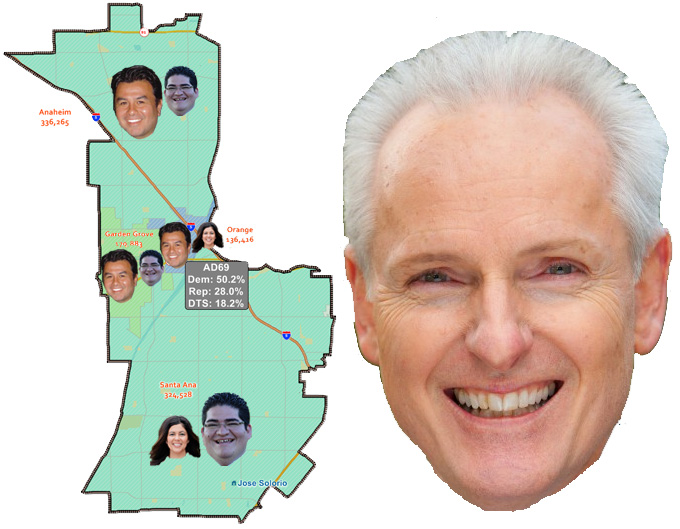
(Thanks to Matt Rexroad and Chandra Sharma at Meridian Pacific for the map, which I’ve cropped here and to which I have added graphics.  Note that the population numbers on the map apply to each whole city, not just the portion of the city in AD-69.  The bulk of Santa Ana and a sliver of Garden Grove are in AD-69 while a sliver of Santa Ana and the bulk of Garden Grove are in AD-72.  A sliver of Orange is in AD-69 but the bulk of it is in AD-68.  Anaheim is divided into nearly even thirds, with the western 1/3 in AD-65, the central 1/3 in AD-69, and the eastern 1/3 in AD-68.)

Daly was consistently first in each city while Barragan was consistently fifth.  Moreno, Perez, and Martinez swapped around for the second, third, and fourth place positions.  The humongous Daly head is indicative of his first place finish in all four cities; taking his head out of the individual cities allows us to more closely examine second and third place, which actually differed in the four cities.  In each individual city, the candidate with the larger head came in second while the candidate with the smaller head came in third:

  • Moreno came in second with Perez third in Anaheim and Garden Grove.
  • Perez came in second with Martinez third in Santa Ana.
  • Moreno came in second with Martinez third in Orange.

Here’s their vote totals broken down visually by city:

Since Daly came in first by such a large margin (indeed, Daly’s Santa Ana total nearly bested everyone else’s districtwide total) and Barragan fell to fifth by such a large margin (Daly’s Garden Grove total outpaced Barragan’s districtwide total), let’s take a closer look with just Moreno, Perez, and Martinez, who were closer together in the results:

It’s clear that without Anaheim, Perez would have made it into the top two and on to November, rather than Moreno.  Moreno’s final vote total was 5,980 while Perez’s was 5,738.  Without Anaheim, Moreno would have had 4,105 while Perez would have had 4,308. (Anaheim gave Moreno 1,875 votes and Perez 1,430 votes, a 445-vote margin).  Perez lost districtwide to Moreno by 242 votes; without Anaheim, Moreno would have lost to Perez by 203 votes.

Anaheim was a crucial stronghold for Moreno, as he came in fourth in Santa Ana but second in Anaheim.

However, with so few cities in AD-69, and Santa Ana such a strong majority of that district (59% of registered voters in AD-69 live in Santa Ana, and 60% of ballots cast in AD-69 were from Santa Ana), it would be more useful to break this result down into regions smaller than cities.  Luckily for this purpose, the City of Santa Ana has Council wards.

Here, the larger head came in first while the smaller head came in second:

  • Daly came in first with Moreno second in Wards 3 and 6.
  • Perez came in first with Daly second in Wards 1 and 4.
  • Perez came in first with Martinez second in Wards 2 and 5 (Martinez represents Ward 2 on the Santa Ana City Council, by the way).

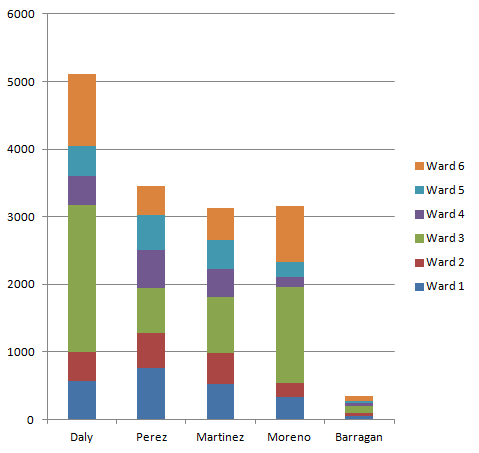
Despite the fact that Perez won four wards and Daly only won two, Daly actually won Santa Ana by a 10% margin.  How?  Well, 48% of registered voters in Santa Ana live in the two wards that Daly won: Wards 3 and 6.  49% of Santa Anans who voted in the AD-69 race live in Wards 3 and 6, so those two wards did not have disproportionate voter turnout – they just have a disproportionate share of the voters to begin with.  A picture is worth a thousand words, so…

The overwhelming majority of Daly and Moreno’s votes in Santa Ana came from Wards 3 and 6, with 59% of Daly’s Santa Ana votes and 66% of Moreno’s Santa Ana votes coming from those two wards.  By contrast, 29% of Perez’s Santa Ana votes and 38% of Martinez’s Santa Ana votes came from those two wards.  Here’s each candidate’s vote totals broken down visually by ward:

Once again, due to Daly’s landslide first-place finish and Barragan’s distant fifth-place finish, let’s take a closer look with just Moreno, Perez, and Martinez, who were closer together in the results:

Perez’s vote totals were fairly evenly spread out across the wards, Martinez got a bump from Ward 3, but Moreno’s performance was very strong in Wards 3 and 6 and disastrous in Wards 2, 4, and 5.

Had Perez done a stronger push in Anaheim or a three-prong strategy in Anaheim, Santa Ana’s Ward 3, and Santa Ana’s Ward 6, there’d be a Democrat vs. Democrat intraparty battle in AD-69 in November between business-backed Tom Daly and union-backed Julio Perez.

Posted in 69th Assembly District | Tagged: , , , , , , , , , , , , , , | 3 Comments »

U.S. Supreme Court Upholds Obama Health Care Law; Declares Lying About Receiving the Medal of Honor is Free Speech

Posted by Chris Nguyen on June 28, 2012

In a busy day at the Supreme Court, the justices issued their first opinion of the day.  They ruled 6-3 in United States v. Alvarez that it is within a person’s First Amendment rights to lie about receiving the Medal of Honor, striking down the Stolen Valor Act as unconstitutional.  Conservative Chief Justice John Roberts joined conservative swing voter Anthony Kennedy and the court’s four liberal justices: Elena Kagan, Sonia Sotomayor, Stephen Breyer, and Ruth Bader Ginsburg.  The dissenters were conservative justices Samuel Alito, Clarence Thomas, and Antonin Scalia.  Kennedy authored the opinion.

The second opinion of the day was the one everyone was waiting for: in a 5-4 decision in National Federation of Independent Businesses v. Sebelius, the U.S. Supreme Court upheld the entire health care law officially known as the Affordable Care Act but often called Obamacare.  The individual mandate was held unconstitutional under the Commerce Clause but was upheld under the power to tax.  The shocker: swing voter Anthony Kennedy was in the dissent.  It was conservative Chief Justice John Roberts who not only voted with the four liberal justices but who wrote the opinion.

Posted in National | Tagged: , , , , , , , , , , | 4 Comments »