OC Political

A right-of-center blog covering local, statewide, and national politics

Archive for the ‘California’ Category

Assembly Democrats Join Senate Democrats In Assault On Public Records Act (Updated)

Posted by Greg Woodard on June 19, 2013

Following up on Chris Emami’s story from yesterday, as reported by the OC Register today, the Assembly passed AB76, which has identical language to SB71, and will be submitted to Governor Brown for his signature.  Every Republican legislator in the Assembly and Senate (except Tom Berryhill – 14th Senate District who is listed as “Other”) opposed both AB76 and SB71, and just a single Democrat voted no for either bill (Senator Leland Yee – 8th Senate District).  If Governor Brown signs the bill into law, it will eviscerate the open government protections of the Public Records Act by making local agencies’ compliance with the Act voluntary instead of mandatory.

Courts interpreting the Public Records Act have consistently held that the Act is to be read broadly in favor of disclosure of documents to the public, and the Act has only a few categories that are exempt from disclosure (and when a local agency refuses to provide documents, it must explain why).  Under AB76, disclosure will be voluntary, meaning that local agencies can refuse to provide documents, and do not have to provide any reason for the refusal.

Ironically (or perhaps not when it comes to Democrats and their legislative tactics), AB76 was added as a budget trailer bill.  Trailer bills are often drafted in secret, sometimes just days or hours before they are voted on in both houses of the state legislature.  You read that right, a bill that allows local agencies more secrecy and less transparency was drafted in a most un-transparent manner.

Journalists often use the Public Records Act to sniff out public corruption.  The City of Bell scandal was exposed in part by use of the Act, as have many other stories of local government waste and fraud.  In addition, private individuals and groups often use the Act to obtain documents needed to challenge local government decisions that affect their property or the environment.  If the changes to the Act become law, local agencies who are hiding things from the public will no longer be compelled to produce any documents, and scandals will go unexposed.

Assemblyman Don Wagner, 68th Assembly District, says AB76 highlights the dangers created by the Democrats’ stranglehold on power in Sacramento: “AB 76 shows why the entire public — Republicans and Democrats alike — should be worried about one party rule.  Eliminating compliance with the Public Records Act has nothing to do with the budget.  So why is this abomination in a so-called Budget Bill?  Because Democrats have complete control and can do it this way to avoid the public scrutiny that comes with committee hearings and an open discussion through the normal legislative process.  This bill, written behind closed doors without a shred of bipartisan input, shields even more government behind those very same closed doors.  The public should be appalled.”

As Emami said in his story, this is a terrible bill that will have a dramatic negative impact on local government transparency.  Democrats apparently believe that secretly passing bills that allow local agencies to act with more secrecy is good government.  I hope that most Californians disagree.

****UPDATE****

As Don Wagner mentioned yesterday, Sacramento Democrats have done one of the most rapid u-turns ever (perhaps the nuclear retort from the media inspired them).  Wagner reported this afternoon that the Assembly voted today to pass the same budget trailer bill as AB76, but without the provisions that would eviscerate the Public Records Act.  While the Senate initially resisted similar efforts, reports are coming out that they will acquiesce and pass a similar bill to the Assembly’s fix.  Governor Brown is expected to sign the fix, therefore preserving the Public Records Act in its current form, which is a good thing for all Californians.

Wagner also reported that both the Assembly and Senate will propose constitutional amendments to eliminate the state’s obligation to reimburse local agencies for Public Records Act compliance.  (Warning, boring political inside baseball stuff ahead).  Apparently, when the Legislature ended redevelopment agencies (another measure that crossed the aisle considerably), the local agencies got too cute and started seeking reimbursement from the state for the cost of every minute copy, office supply, etc. that they incurred for compliance with the Public Records Act but previously had not sought reimbursement for.  That may have taken the Democrats in Sacramento by surprise but unfortunately their “fix” would have ended open government as we know it in this state.  I guess the moral for Democrats is not to target the media’s bread and butter because they actually start doing their job when you threaten the source of their juiciest stories.

I would like to return the favor and thank Don for all of his information and for all of the Republicans in Sacramento and their efforts to undo this terrible stinker of a Democratic bill.

Stay tuned in case there are even more breaking updates.

Posted in California, State Assembly, State Senate | Tagged: , , , , | 5 Comments »

SB 71 Passing Could Reduce Transparency In Government

Posted by Former Blogger Chris Emami on June 18, 2013

A reader sent me an article this morning from the Southern California Public Radio Blog discussing the impact of SB 71 which is slated to be signed soon by Governor Brown. The bill does not outright abolish the California Public Records Act, but it does in my opinion create a loophole that could be used to avoid compliance with the act. I suggest that our readers take a look at the blog article on their website.


Changes to Public Records Act stirs controversy
Julie Small | June 18th, 2013

If, as expected, Governor Jerry Brown signs Senate Bill 71 this week, local government agencies will no longer be required to follow key provisions of California’s Public Records Act. The bill was part of the budget state lawmakers enacted over the weekend.

California law requires local governments to respond to public requests for information within 10 days. For example, a citizen could ask to see contracts that a city awards an independent contractor. If the municipality is unable to meet such a request, or if they reject it, they have to explain why. Both those requirements are about to be suspended for local governments.

The state maintains this is a budget move, because it has to reimburse local governments for complying with some aspects of records requests. The Department of Finance estimates that exempting local governments from those requirements could save the state tens of millions of dollars a year.

But Peter Scheer of the First Amendment Coalition says the change will create opportunities for local authorities to cut off public access to information:

“People are going to file public records request for records that they need, and under this new legal language,  a local city or a county is going to be able to write back and say ‘denied’ and they’re not going to tell you why…I think that’s just crazy.”

But the Finance Department’s H.D. Palmer says local governments can adopt their own process — and he expects they will: “We believe that these are best practices that local governments have and will continue to abide by.”

And if they don’t, Palmer said local agencies will “have to tell everyone publicly in an open meeting, and they could conceivably be leaving themselves open to litigation.”

The public still has a legal right to information about local governments — and an expectation they’ll get it.

Jean Hurst with the California State Association of Counties agrees.  After all, she says, local governments have provided public access to data for more than a decade now:

“I think a local agency would be hard pressed to say in an open meeting, ‘We’re no longer going to respond in a timely manner to your request for public records.’   That would be just surprising to me.”

Hurst believes the public expectation of transparency, and the threat of lawsuits, will prompt agencies to comply with the entire Public Records Act — “for the most part”.

But Jim Ewert, an attorney for the California Newspaper Publishers Association, thinks it’s naive to expect all local agencies and authorities will fall in line. Case in point:  the former administrator for the City of Bell:

“Can you imagine Robert Rizzo having the opportunity to just say no, or actually not say anything at all, when people ask for public information?”

Ewert hopes to get the legislature to reinstate the provisions of California’s Public Records Act they just voted to suspend.

This bill is a terrible idea. As somebody that has made quite a few public records requests over the past few years, I can honestly say that most city staff members are extremely friendly, easy to work with, and timely in their responses. Some cities have gone over the 10 days and I have not reported it because they kept an open line of communication and were honest about the delays. Without naming any names, some cities are extremely belligerent and extremely tough to deal with. SB 71 would give these “belligerent” cities some leverage that they do not deserve to have (refer to the Robert Rizzo quote above).

Posted in California | 2 Comments »

Sacramento Saga Continues: U.S. Attorney subpoenas Senator de León

Posted by Allen Wilson on June 7, 2013

OC Political reported breaking news on Tuesday regarding Senator Ron Calderon (D-Whittier) office was raided by the FBI.

My colleague Chris Nguyen elaborated with an article following up the breaking news about Senator Calderon and the FBI raid.

Now, it is reported by the Sacramento Bee that U.S. Attorney has subpoena Senator Kevin de León (D-Los Angeles).

In a statement, Senator de León said he received a subpoena on Thursday.

The Sacramento Bee reports that Senator de León intended “to cooperate fully” and will be interviewed by a grand jury in July.

As the saga coming out of Sacramento continues OC Political will be on top of the story to bring you the latest updates.

Posted in California, State Senate, Uncategorized | Tagged: , , , , , | 3 Comments »

Update on Calderon FBI Raid: Latino Caucus Office Also Raided, Part of LA County Corruption Investigation

Posted by Chris Nguyen on June 4, 2013

Senator Ron Calderon (D-Montebello)

Senator Ron Calderon
(D-Montebello)

OC Political blogger Allen Wilson reported two hours ago that the FBI had raided the Capitol office of Senator Ron Calderon (D-Montebello).  Matt Rexroad of Meridian Pacific notes ironically that Calderon represents the City of Bell in the State Senate.

In addition to raiding Calderon’s Capitol office, the FBI also raided the office of the California Latino Legislative Caucus, located in the Legislative Office Building, which is across street from the Capitol.  Calderon is a member of the Caucus, but the Chair is Senator Ricardo Lara (D-Bell Gardens) and the Vice Chair is Assemblyman V. Manuel Perez (D-Coachella).  Lara told the LA Times he had “no idea” why the Caucus office was being raided.  Calderon and his staff have not responded to requests for comment from various media sources. (Update – June 5, 8:20 PM: The Senate Chief Sergeant-at-Arms has issued a retraction of their statement from yesterday; the Caucus office was not raided – it was a second Calderon office.  Scroll to the end of this post for the full update.)

The two raids were executed based on an investigation by the United States Attorney for the Central District of California.  (The Central District of California consists of Los Angeles, Orange, Riverside, San Bernardino, San Luis Obispo, Santa Barbara, and Ventura Counties.)

Though the warrants are sealed, multiple media sources have reported this is part of a wider federal investigation into public corruption in Los Angeles County.

Calderon, who is termed out of the Senate in 2014, has committees open for the 58th Assembly District, currently represented by freshman Assemblywoman Cristina Garcia (D-Bell Gardens), and for State Controller.  When Treasurer Bill Lockyer announced he would retire after the 2014 election rather than run for Controller (as we noted this morning on OC Political), Calderon’s bid for Controller got a big boost; this FBI raid likely cripples Calderon’s bid for controller.

Ron Calderon’s brother, former Senator Charles Calderon (D-Whittier), told the Sacramento Bee: “I’m shocked. Right now we don’t know any facts, and without facts you speculate about the worst. But I know Ron and…I am very confident that he’ll be able to work through this and that when the facts do come out they will show him to have not been involved in anything.”

The office of Assemblyman Ian Calderon (D-Whittier), Charles Calderon’s son and Ron Calderon’s nephew, was not part of today’s raids.

Today’s pair of raids are the first FBI raids in the State Capitol since the 1980s when the Shrimpscam investigation resulted in the conviction and imprisonment of Board of Equalization Member Paul Carpenter (D-Los Angeles), Senator Joseph Montoya (D-La Puente), Assemblyman Pat Nolan (R-Glendale), and Assemblyman Frank Hill (R-Whittier).

Update – June 5, 8:20 PM: It turns out the office of the Latino Caucus was not raided.  It was a second office of Senator Ron Calderon.  KQED-FM published this statement from State Senate Chief Sergeant-at-Arms Tony Beard:

Yesterday afternoon, agents from the Federal Bureau of Investigation served sealed warrants to search an office in the State Capitol and the Legislative Office Building.

One of those offices was erroneously identified as an office of the Legislative Latino Caucus, based on an outdated roster of room numbers. The Legislative Latino Caucus moved into new offices earlier this year.

Both offices that are subject to the sealed search warrants are the offices of Senator Calderon; one in the Capitol building and the other in the Legislative Office Building.

This correction illustrates the limited information available to the Legislature. We have and will continue to fully cooperate with the agents.

Posted in California | Tagged: , , , , , , , , , , , , , , | 3 Comments »

The Horror Of The Lockyer Bank Account

Posted by Former Blogger Chris Emami on June 4, 2013

I have to give all the credit to Chris Nguyen for coming up with the headline for this post. He and I were discussing business yesterday and the topic of elected officials retiring came up. Until he mentioned it, I had no clue that California Treasurer Bill Lockyer had announced his retirement.

Bill-Lockyer


I did confirm that Lockyer announced his retirement yesterday through an article on Capitol Alert.

Lockyer, 72, a longtime fixture in Democratic politics in California, will leave the Capitol having never lost an election – from a school board contest in San Leandro in 1968 to the Assembly and Senate and then 16 years in statewide office.

Republicans may be thinking to themselves that this is amazingly great news because it frees up a statewide seat for us to contend for. However, they are not taking into account that Bill Lockyer has over $2,000,000 just lying around with nowhere to spend it. He likely won’t spend this on the race for treasurer  as it is widely expected that John Chiang who currently holds the office of California Controller is the definite front-runner for the seat.

I expect to see this money end up in a Super PAC and end up getting spent on some different races throughout California (Congress, Ballot Measure, etc…).

Posted in California | Tagged: | 1 Comment »

States Where You Cannot Make A Safe Run

Posted by Former Blogger Chris Emami on May 28, 2013

By no means am I any less busy than I was before my post stating that I was taking a bit of a break from the blog, but I am trying to crank out a few posts over the next couple of weeks. Many have asked why I was taking the break and I pointed out that a lot of real estate investors have been calling me about potentially flipping houses (Yes, I am a Realtor. Please forgive my shameless plug).

Today, a friend sent me an interesting e-mail about many states having a law stating that you must resign from your current office that you hold in order to run for another one. This type of law would require a candidate to commit to a race and not have the option of making a safe run.

The article did come from Wikipedia and I will openly disclose that now, but I did go through and verify the information on the different websites needed to do so for each state:

Arizona

Section 38-296 of the Arizona Revised Statutes, entitled “Limitation upon filing for election by incumbent of elective office” states:

  1. Except during the final year of the term being served, no incumbent of a salaried elective office, whether holding by-election or appointment, may offer himself for nomination or election to any salaried local, state or federal office.
  2. An incumbent of a salaried elected office shall be deemed to have offered himself for nomination or election to a salaried local, state or federal office upon the filing of a nomination paper pursuant to section 16-311, subsection A or formal public declaration of candidacy for such office whichever occurs first.”

There is no definition of what constitutes a “formal public declaration,” thereby creating an ambiguity that is currently a matter of controversy in Arizona.

Florida

Section 99.012 of the Florida Statutes states: “No officer may qualify as a candidate for another public office, whether state, district, county or municipal, if the terms or any part thereof run concurrently with each other, without resigning from the office he or she presently holds.”

Georgia

Article II, Section 2, Paragraph V of the 1983 Constitution of Georgia reads: “The office of any state, county, or municipal elected official shall be declared vacant upon such elected official qualifying, in a general primary or general election, or special primary or special election, for another state, county, or municipal elective office or qualifying for the House of Representatives or the Senate of the United States if the term of the office for which such official is qualifying for begins more than 30 days prior to the expiration of such official’s present term of office.”

Hawaii

In 1978, Article II, Section 7 was added to the Constitution of Hawaii to include resign-to-run: “Any elected public officer shall resign from that office before being eligible as a candidate for another public office, if the term of the office sought begins before the end of the term of the office held.”

Texas

Article 16, Section 65(b) of the Constitution of Texas states: “If any of the officers named herein shall announce their candidacy, or shall in fact become a candidate, in any General, Special or Primary Election, for any office of profit or trust under the laws of this State or the United States other than the office then held, at any time when the unexpired term of the office then held shall exceed one year and 30 days, such announcement or such candidacy shall constitute an automatic resignation of the office then held, and the vacancy thereby created shall be filled pursuant to law in the same manner as other vacancies for such office are filled.”

The “officers named herein” are listed in Article 16, Section 65(a):

  • District Clerks
  • County Clerks
  • County Judges
  • Judges of the County Courts at Law
  • Judges of the County Criminal Courts
  • Judges of the County Probate Courts
  • Judges of the County Domestic Relations Courts
  • County Treasurers
  • Criminal District Attorneys
  • County Surveyors
  • County Commissioners
  • Justices of the Peace
  • Sheriffs
  • Assessors and Collectors of Taxes
  • District Attorneys
  • County Attorneys
  • Public Weighers
  • Constables

I would love to hear what our readers think about California implementing a law like this. What are your thoughts?

Posted in California | 3 Comments »

Buy Your Own Assembly License Plate

Posted by Chris Nguyen on May 6, 2013

LicensePlateA72AH/T to my friend Alex Vassar at the One Voter Project for this odd story.  Some of you may recall when OC Political broke the story of the DUI arrest of former 72nd District Assemblyman Richard Robinson (D-Garden Grove).  A key tip in IDing Robinson was his Assembly license plate, which read “A 72 R” on it.  Robinson served in the Assembly from 1974-1986.

Well, now you can your very own “A 72 A” license plate.  The plates belonging to former 72nd District Assemblyman John Quimby (D-San Bernardino), who served from 1962-1974, are now available on eBay.  Quimby died less than five months ago on December 22, 2012, at the age of 77.  His eponymous Quimby Act of 1965 is the law that permits local governments to require developers to donate up to five acres of land for parks per every 1,000 residents expected to move into newly-constructed housing.

The plates are available for $300 until Wednesday, May 22 at 5:06 PM.  Shipping from Yolo County is free though Californians have to pay 7.5% sales tax, which on a $300 product is $22.50.  Click here for a quick look at State Assembly, State Senate, Congressional, and U.S. Senate license plates from the California DMV.

Posted in 72nd Assembly District, California | Tagged: , | 1 Comment »

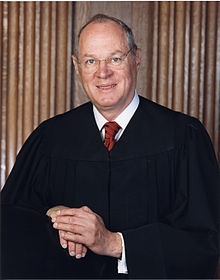
Do Justice Kennedy’s Prior Rulings Tell Us What He’ll Do in the Prop 8 and DOMA Cases?

Posted by Chris Nguyen on March 26, 2013

I usually loathe reposting old stories from our blog, but in light of the fact that the U.S. Supreme Court is hearing arguments in Hollingsworth v. Perry (Prop 8 case) today and United States v. Windsor (DOMA case) tomorrow, I thought I would repost the story I wrote back on February 8, 2012, after the Ninth Circuit Court of Appeals threw out Prop 8.  (OC Political was a mere nine days old at that point, with our first post going up on January 31, 2012.)  The Supreme Court will likely issue its ruling in June.

Everyone expects Justice Anthony Kennedy to be pivotal in deciding what will happen in these two cases.

Here’s what I wrote on February 8, 2012:

After yesterday’s ruling from the U.S. Ninth Circuit Court of Appeals, Prop 8 supporters jeered, and Prop 8 opponents cheered.  The news showed jubilant same-sex marriage supporters celebrating the ruling and resolute traditional marriage supporters vowing to appeal.

In the May 2009 California Supreme Court ruling in Strauss v. Horton, the result was the opposite, with Prop 8 upheld.  The August 2010 U.S. District Court ruling in Perry v. Schwarzenegger struck down Prop 8.  Yesterday’s ruling by a three-judge panel of the U.S. Ninth Circuit Court of Appeals in Perry v. Brown upheld the District Court.  Prop 8 proponents have 90 days (well, technically, 89 as of this morning) to decide whether to appeal to an 11-judge en banc panel of the U.S. Ninth Circuit Court of Appeals or to appeal directly to the U.S. Supreme Court.

If there’s any lesson to be learned from all the court battles involving Prop 8, it’s that it doesn’t matter what a particular court rules, the side that wins hails the ruling as a historic victory in defense of the legal concepts they support while the side that loses vows to go to another court.  The only way this cycle ends is to take this to the highest court in the land: only the United States Supreme Court can decide this issue once and for all.

In all likelihood, U.S. Supreme Court Justices John Roberts, Antonin Scalia, Clarence Thomas, and Samuel Alito will vote to uphold Prop 8 while Justices Stephen Breyer, Ruth Bader Ginsburg, Sonia Sotomayor, and Elena Kagan will vote to strike down Prop 8.  This means that whether marriage means one man and one woman or whether it means two people of any sex in California and in America rests in the hands of one man: U.S. Supreme Court Justice Anthony Kennedy.

There’s a certain irony that Kennedy will be the key to this issue, since Prop 8 comes from California, and Kennedy is a native Californian who spent the majority of his life in this state and was appointed to the Supreme Court by fellow Californian Ronald Reagan.  A Catholic educated at Stanford University and Harvard Law School, Kennedy was a lawyer in private practice and has been a law professor at McGeorge School of Law during his time as a lawyer and continuing to the present day.

Kennedy’s judicial track record does not make it clear how he’d come down on this issue.

In Beller v. Middendorf (1980), Kennedy (a Ninth Circuit Court of Appeals Judge back then) wrote the decision that upheld the ability of the U.S. Navy to discharge sailors for “engaging in homosexual acts.”  In Hurley v. Irish-American Gay, Lesbian & Bisexual Group of Boston (1995), he joined a unanimous Supreme Court opinion allowing the St. Patrick’s Day Parade to exclude an Irish gay group.

In Romer v. Evans (1996), Kennedy wrote the decision invalidating a Colorado ballot measure prohibiting sexual orientation from becoming a protected class (protected classes include race, religion, etc.).  In Boy Scouts of America v. Dale (2000), Kennedy voted to uphold the right of the Boy Scouts of America as a private organization to exclude gay men from being scoutmasters.

Both sides of the issue can find favorable parts of Lawrence v. Texas (2003), where Kennedy wrote, “the Texas [anti-sodomy] statute furthers no legitimate state interest which can justify its intrusion into the personal and private life of the individual” but also wrote that the case “does not involve whether the government must give formal recognition to any relationship that homosexual persons seek to enter.”  So Lawrence v. Texas tells us that Kennedy opposed attempts to regulate the conduct of consenting adults but also wanted to make clear that the decision did not affect marriage.

In Christian Legal Society v. Martinez (2010), Kennedy joined a court decision that allowed a public school to refuse recognition to a student group that wished to exclude gay members.

Kennedy’s dizzying array of court decisions leaves little clarity as to how he will rule.  However, there is little doubt that the fate of Proposition 8 and of the definition of marriage in California and America rests in the hands of one Californian above all others: Anthony Kennedy.

Of course, we mustn’t forget that Chief Justice John Roberts could somehow determine that traditional marriage, same-sex marriage, all forms of marriage, Prop 8, or DOMA is a tax, and comes up with a ruling that surprises everyone (see excerpt of June 28 post below), but then again there is the marriage penalty:

The second opinion of the day was the one everyone was waiting for: in a 5-4 decision in National Federation of Independent Businesses v. Sebelius, the U.S. Supreme Court upheld the entire health care law officially known as the Affordable Care Act but often called Obamacare.  The individual mandate was held unconstitutional under the Commerce Clause but was upheld under the power to tax.  The shocker: swing voter Anthony Kennedy was in the dissent.  It was conservative Chief Justice John Roberts who not only voted with the four liberal justices but who wrote the opinion.

Posted in California, National | Tagged: , , , , , , , , , , , , , , , , | Leave a Comment »

California’s Two Highest Paid State Employees Fired in Four-Month Span

Posted by Chris Nguyen on March 25, 2013

Making a combined salary of $5 million in 2011, California’s two highest paid state employees were cut from the state payroll in the last four months.

Hired in late 2001, the state’s highest paid state employee made $2.88 million in 2011.  He was fired in November after six years of subpar performance at UC Berkeley.

Hired in early 2003, the state’s second-highest paid state employee made $2.15 million in 2011.  He was fired over the weekend after five years of declining performance at UCLA.

Little surprise, all five of the top five highest-paid state employees (from 2011, the latest year with numbers available) came from the University of California system’s payroll.  With those two gone, the highest earners from 2011 still collecting state salaries are UCLA’s Ronald Busuttil ($1.98 million), UCSF’s Anthony Azakie ($1.81 million), and UCSF’s Philip Leboit ($1.53 million).

tedfordhowlandOh, those two who were fired?  The one fired in November was Jeff Tedford, Head Coach of the Cal Football, and the one fired over the weekend was Ben Howland, Head Coach of the UCLA Men’s Basketball team.

For some of our readers, you saw this a mile away as soon as you read the headline.  For other readers, this raised your hackles at the start of this post and is still an outrage.

Back in July, I had written a post about the massive $169 million subsidies that the UC and CSU systems provide to Division I athletic programs.  This is a net cost that already accounts for all revenues provided by these athletic programs to the universities.

UCLA spent $2.59 million in subsidies to its athletic programs while UC Berkeley spent more than four times as much, with $10.51 million in subsidies to its athletic programs.

As I noted in July:

At a time of budget cuts, tuition increases, class reductions, and enrollment reductions, should UC & CSU really be spending this much money to subsidize athletics?  Aren’t athletic departments supposed to subsidize the universities, not the other way around?

Posted in California | Tagged: , , , , , , , | 1 Comment »

Moorlach: “…OC Political blog announced my intentions…”

Posted by Newsletter Reprint on March 9, 2013

This came over the wire from the office of Supervisor John Moorlach on Tuesday…

MOORLACH UPDATE — Huffington Post — March 5, 2013

Lamar Alexander, when he ran for U.S. President, would frequently say, “Aim for the top, there’s more room there.”  So, that’s what I’m doing.  If you want to get a good sense of the internal debate I’m currently enjoying, then the piece in the Huffington Post below should be of interest.  The writer does an excellent job of laying out the land. 

As you read the piece, let me clarify one thing.  I am not seeking publicity.  I had been keeping my phone calls so confidential, that when the OC Political blog announced my intentions, I had to call an emergency meeting to inform my staff of what I was considering.  And now I have to call friends with an apology that the news leaked before I had a chance to call and discuss the matter with them first.  Should someone else announce their intention to run for Governor, and it makes sense for me to support that person, then I’m out of the hunt.  And then I’ll consider other options.   After you read the piece, know that I am still moving forward with my decision process to aim for the top. Read the rest of this entry »

Posted in 2nd Supervisorial District, California | Tagged: , , | 2 Comments »