OC Political

A right-of-center blog covering local, statewide, and national politics

Author Archive

Update on Calderon FBI Raid: Latino Caucus Office Also Raided, Part of LA County Corruption Investigation

Posted by Chris Nguyen on June 4, 2013

Senator Ron Calderon (D-Montebello)

Senator Ron Calderon
(D-Montebello)

OC Political blogger Allen Wilson reported two hours ago that the FBI had raided the Capitol office of Senator Ron Calderon (D-Montebello).  Matt Rexroad of Meridian Pacific notes ironically that Calderon represents the City of Bell in the State Senate.

In addition to raiding Calderon’s Capitol office, the FBI also raided the office of the California Latino Legislative Caucus, located in the Legislative Office Building, which is across street from the Capitol.  Calderon is a member of the Caucus, but the Chair is Senator Ricardo Lara (D-Bell Gardens) and the Vice Chair is Assemblyman V. Manuel Perez (D-Coachella).  Lara told the LA Times he had “no idea” why the Caucus office was being raided.  Calderon and his staff have not responded to requests for comment from various media sources. (Update – June 5, 8:20 PM: The Senate Chief Sergeant-at-Arms has issued a retraction of their statement from yesterday; the Caucus office was not raided – it was a second Calderon office.  Scroll to the end of this post for the full update.)

The two raids were executed based on an investigation by the United States Attorney for the Central District of California.  (The Central District of California consists of Los Angeles, Orange, Riverside, San Bernardino, San Luis Obispo, Santa Barbara, and Ventura Counties.)

Though the warrants are sealed, multiple media sources have reported this is part of a wider federal investigation into public corruption in Los Angeles County.

Calderon, who is termed out of the Senate in 2014, has committees open for the 58th Assembly District, currently represented by freshman Assemblywoman Cristina Garcia (D-Bell Gardens), and for State Controller.  When Treasurer Bill Lockyer announced he would retire after the 2014 election rather than run for Controller (as we noted this morning on OC Political), Calderon’s bid for Controller got a big boost; this FBI raid likely cripples Calderon’s bid for controller.

Ron Calderon’s brother, former Senator Charles Calderon (D-Whittier), told the Sacramento Bee: “I’m shocked. Right now we don’t know any facts, and without facts you speculate about the worst. But I know Ron and…I am very confident that he’ll be able to work through this and that when the facts do come out they will show him to have not been involved in anything.”

The office of Assemblyman Ian Calderon (D-Whittier), Charles Calderon’s son and Ron Calderon’s nephew, was not part of today’s raids.

Today’s pair of raids are the first FBI raids in the State Capitol since the 1980s when the Shrimpscam investigation resulted in the conviction and imprisonment of Board of Equalization Member Paul Carpenter (D-Los Angeles), Senator Joseph Montoya (D-La Puente), Assemblyman Pat Nolan (R-Glendale), and Assemblyman Frank Hill (R-Whittier).

Update – June 5, 8:20 PM: It turns out the office of the Latino Caucus was not raided.  It was a second office of Senator Ron Calderon.  KQED-FM published this statement from State Senate Chief Sergeant-at-Arms Tony Beard:

Yesterday afternoon, agents from the Federal Bureau of Investigation served sealed warrants to search an office in the State Capitol and the Legislative Office Building.

One of those offices was erroneously identified as an office of the Legislative Latino Caucus, based on an outdated roster of room numbers. The Legislative Latino Caucus moved into new offices earlier this year.

Both offices that are subject to the sealed search warrants are the offices of Senator Calderon; one in the Capitol building and the other in the Legislative Office Building.

This correction illustrates the limited information available to the Legislature. We have and will continue to fully cooperate with the agents.
Posted in California | Tagged: , , , , , , , , , , , , , , | 3 Comments »

Buy Your Own Assembly License Plate

Posted by Chris Nguyen on May 6, 2013

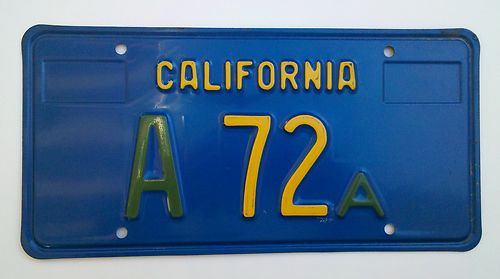
LicensePlateA72AH/T to my friend Alex Vassar at the One Voter Project for this odd story.  Some of you may recall when OC Political broke the story of the DUI arrest of former 72nd District Assemblyman Richard Robinson (D-Garden Grove).  A key tip in IDing Robinson was his Assembly license plate, which read “A 72 R” on it.  Robinson served in the Assembly from 1974-1986.

Well, now you can your very own “A 72 A” license plate.  The plates belonging to former 72nd District Assemblyman John Quimby (D-San Bernardino), who served from 1962-1974, are now available on eBay.  Quimby died less than five months ago on December 22, 2012, at the age of 77.  His eponymous Quimby Act of 1965 is the law that permits local governments to require developers to donate up to five acres of land for parks per every 1,000 residents expected to move into newly-constructed housing.

The plates are available for $300 until Wednesday, May 22 at 5:06 PM.  Shipping from Yolo County is free though Californians have to pay 7.5% sales tax, which on a $300 product is $22.50.  Click here for a quick look at State Assembly, State Senate, Congressional, and U.S. Senate license plates from the California DMV.

Posted in 72nd Assembly District, California | Tagged: , | 1 Comment »

By the Numbers: Stats on the Partisan Affiliations of Local Elected Officials

Posted by Chris Nguyen on March 28, 2013

In case you missed it, OC Political compiled this database of the partisan affiliations of every single local elected official in Orange County last week, updating our prior three databases herehere, and here, from October and November 2012.

Some readers had contacted us, expressing interest in us parsing this data on a more macro scale, so here we go.

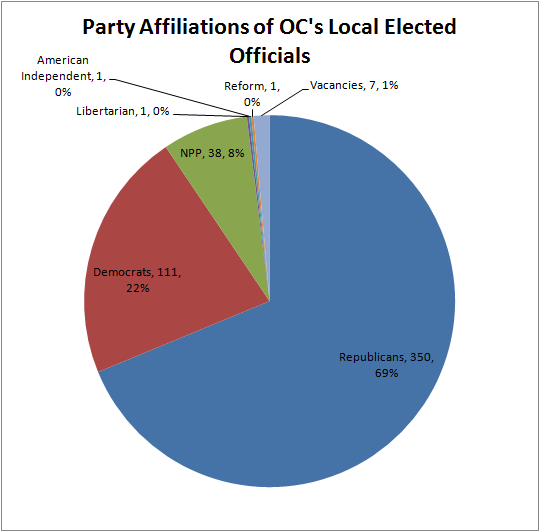
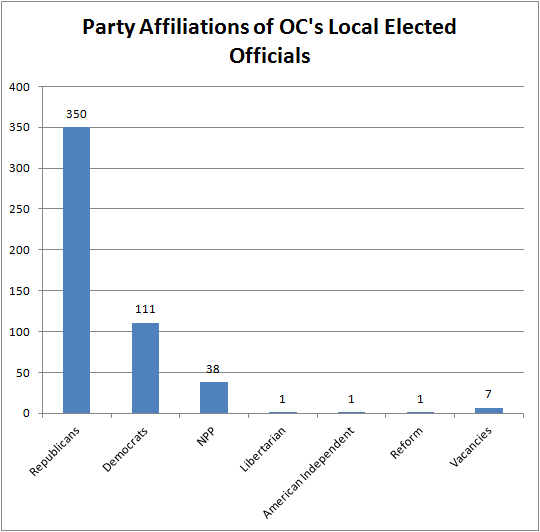
The overwhelming majority of Orange County’s 509 local elected officials are Republicans, with 350 each, followed by 111 Democrats, 38 with no party preference, 3 from third parties, and 7 current vacancies (County Auditor-Controller, County Clerk-Recorder, County Public Administrator, three seats on the Capistrano Bay Community Services District, and one seat on the Surfside Colony Community Services District).  Republicans hold 69% of the seats while Democrats hold 22%.  (To move the needle up to 70% for Republicans or 23% for Democrats, the respective parties would need to gain 4 of the 7 vacancies.)

EverybodyChart

EverybodyPie

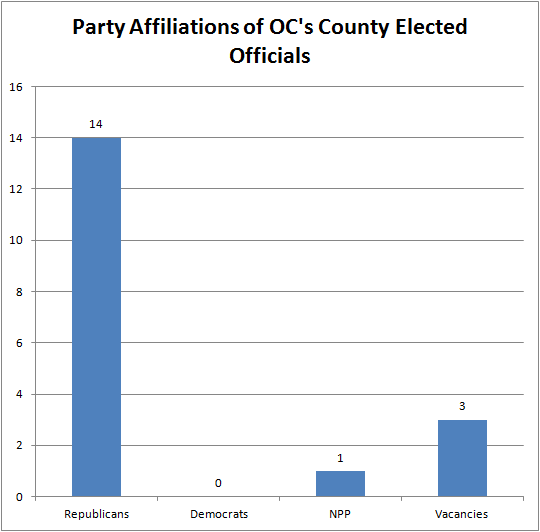
Looking at the County offices, it’s pretty one-sided.  In case you were wondering, the No Party Preference is County Assessor Webster Guillory.  Republicans hold all of the other non-vacant county posts, including all five seats on the County Board of Supervisors and all five seats on the County Board of Education:

CountyChart

CountyPie

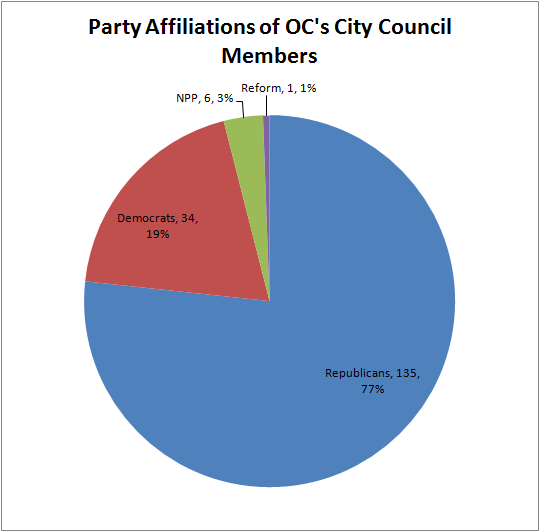
Turning to the City Councils, there are 135 Republicans out of 176 City Council members, with 34 Democrats and 6 NPPs.  The Reform Party member is Gerri Graham-Mejia of Los Alamitos.  Huntington Beach, Newport Beach, and Santa Ana have seven-member councils while all other OC cities have five-member councils.

CouncilChart

CouncilPie

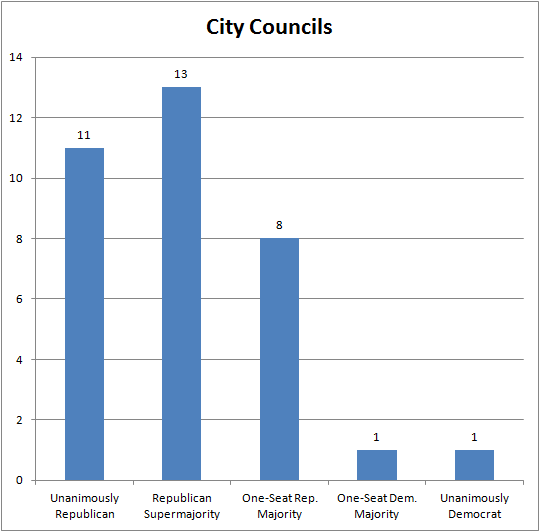
Inherently, all City Councils are multi-member entities, so let’s take a look at party majorities on the Councils.  Out of 34 City Councils:

  • 11 have only Republicans on them
  • 13 City Councils have Republican supermajorities (6 out of 7 for Newport Beach, and 4 out of 5 for the other 12)
  • 8 City Councils have a one-seat Republican majority (4 Republicans and 3 Democrats in Huntington Beach, with the other 7 being Councils with 3 out of 5 Republicans; it’s not all R/D, as Brea has 3 Republicans and 2 NPPs while La Habra has 3 Republicans, 1 Democrat, and 1 NPP); this includes the recently-recaptured Irvine City Council
  • Laguna Woods has three Democrats and two Republicans
  • Santa Ana has Orange County’s only City Council that is comprised entirely of Democrats

CouncilMajChart

CouncilMajPie

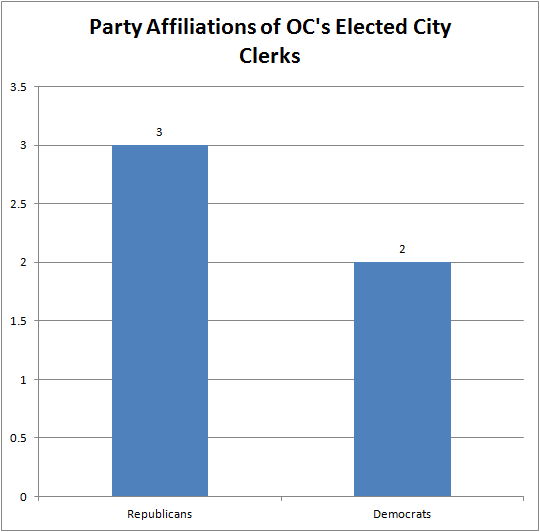
Five OC cities have elected city clerks (Huntington Beach, Laguna Beach, Orange, Placentia, and San Clemente).  Of these, Laguna Beach’s Lisette Chel-Walker and San Clemente’s Joanne Baade are the two Democrats while the other three (Huntington Beach’s Joan Flynn, Orange’s Mary Murphy, and Placentia’s Patrick Melia) are Republicans.

ClerkChart

ClerkPie

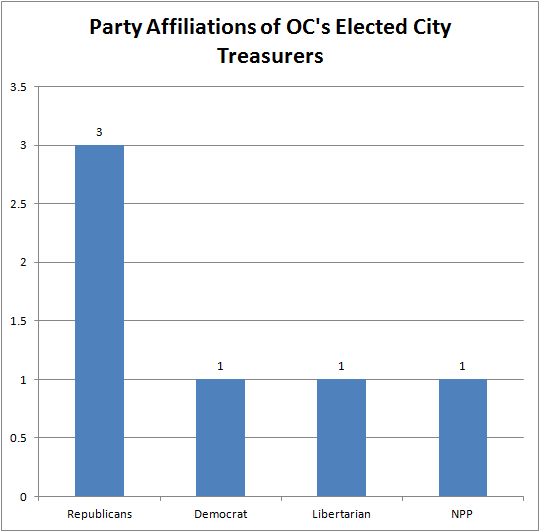
There are six elected City Treasurers, with 3 Republicans (Huntington Beach’s Alisa Cutchen, Orange’s Helen Walker, and Placentia’s Craig Green), 1 Democrat (Brea’s Glenn Parker), 1 NPP (Laguna Beach’s Laura Parisi), and 1 Libertarian (San Clemente’s Mark Taylor, OC’s only Libertarian elected official).

TreasurerChart TreasurerPie

I’m not creating a chart for Huntington Beach Republican Jennifer McGrath, Orange County’s only elected City Attorney.

Moving on to the Community College Districts, which clearly march to a different drum, they are the pride of the OC Democratic Party and the shame of the OC Republican Party.  Of the 26 community college board members, 15 are Democrats, 8 are Republicans, and 3 are NPPs.

CollegeBoardChart CollegeBoardPie

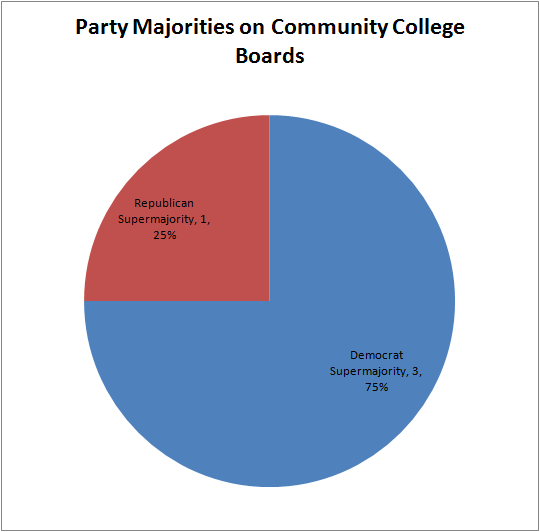
It’s much more stark when you look at party majorities:

  • South Orange County Community College District has five Republicans and two NPPs.
  • Rancho Santiago Community College District has five Democrats, one Republican, and one NPP.
  • North Orange County Community College District has six Democrats and one Republican.
  • Coast Community College District has the only five-member board, with four Democrats and one Republican.

CollegeMajChart CollegeMajPie

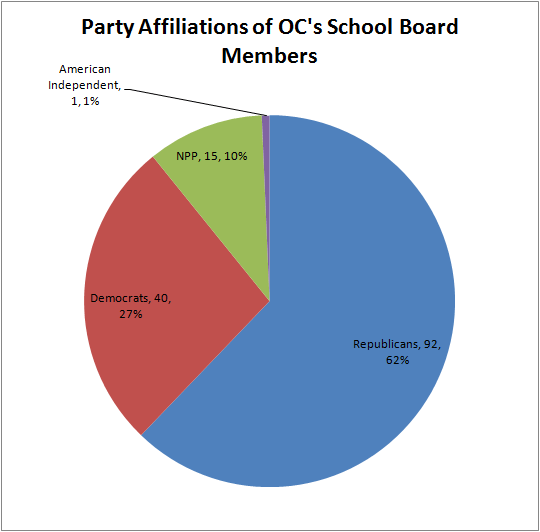
Moving on from the one type of office Democrats control (the community college boards), we head on to school boards. Out of 148 school board members, 92 are Republicans, with 40 Democrats, 15 NPPs, and 1 American Independent (John Ortiz from the Ocean View School District).

SchoolBoardChart SchoolBoardPie

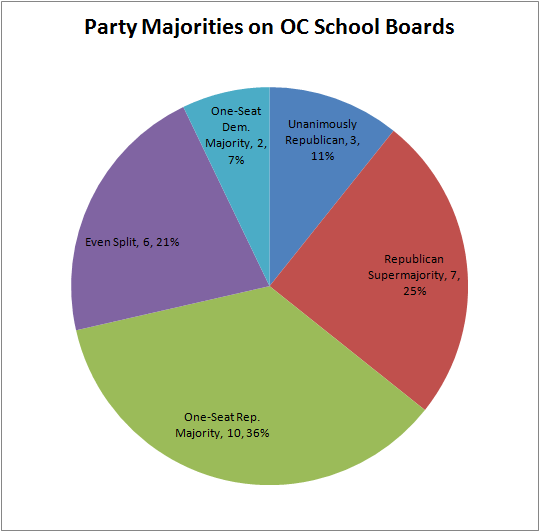
By party majorities, the school boards are much more tenuous, as there are:

  • 3 unanimously Republican school boards (Fullerton Joint Union High School District, Fullerton [Elementary] School District, and Tustin Unified School District)
  • 7 Republican supermajorities (Newport-Mesa Unified has 6 Republicans on a 7-member board, Brea-Olinda Unified and Orange Unified each have 5 Republicans out of 7 school board members, while four other school districts have 4 Republicans out of 5 board members)
  • 10 boards wield a single-seat Republican majority (4 out of 7 in Capistrano Unified are registered Republicans [whether they vote like Republicans is a different story] while the other nine have 3 Republicans on 5-member boards; the minority are not always Democrats, they may be NPPs or AIP).
  • 6 boards wield an actual even split (each of these boards has exactly 2 Republicans, 2 Democrats, and 1 NPP)
  • 2 boards each have 3 Democrats and 2 Republicans (Cypress [Elementary] School District and Westminster [Elementary] School District)

SchoolMajChart SchoolMajPie

…and finally OC’s very special districts.  Of the 129 elected special district board members, 94 are Republicans, 19 are Democrats, 12 are NPPs, and 4 are actually vacancies.

SpecialDistChart SpecialDistPie

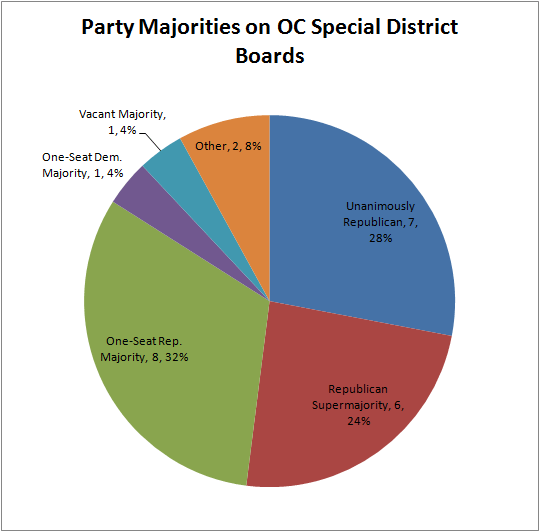
When you look at party control of the boards of each special district, the extent of Republican majorities is quite clear:

  • 7 special district boards have only Republican members
  • 6 special district boards have Republican supermajorities (6 out of 7 on the Orange County Water District and 4 out of 5 members on the other five boards)
  • 8 special district boards have one-seat Republican majorities (2 Republicans and 1 Democrat on the Surfside Colony Stormwater Protection District Board, 3 Republicans and 2 Democrats on the boards of the Rossmoor Community Services District and the El Toro Water District, 3 Republicans and 1 Democrat with 1 vacancy on the Surfside Colony Community Services District Board, and 4 other boards have 3 Republicans, 1 Democrat, and 1 NPP).
  • Democrats wield a one-seat majority on the Buena Park Library District Board, with 3 Democrats, 1 Republican, and 1 NPP
  • Under “other,” I’ve placed the Sunset Beach Sanitary District (2 Republicans, 2 NPPs, and 1 Democrat) and the Placentia Library District (2 Democrats, 2 NPPs, and 1 Republican)
  • Finally, there is the curious case of the Capistrano Bay Community Services District Board, which has 2 Republicans and 3 vacancies; does anyone know how these seats would be filled when the majority of the board seats are vacant?

SpecialMajChart SpecialMajPie

Posted in Democrat Central Committee, Orange County, Republican Central Committee | 3 Comments »

Do Justice Kennedy’s Prior Rulings Tell Us What He’ll Do in the Prop 8 and DOMA Cases?

Posted by Chris Nguyen on March 26, 2013

I usually loathe reposting old stories from our blog, but in light of the fact that the U.S. Supreme Court is hearing arguments in Hollingsworth v. Perry (Prop 8 case) today and United States v. Windsor (DOMA case) tomorrow, I thought I would repost the story I wrote back on February 8, 2012, after the Ninth Circuit Court of Appeals threw out Prop 8.  (OC Political was a mere nine days old at that point, with our first post going up on January 31, 2012.)  The Supreme Court will likely issue its ruling in June.

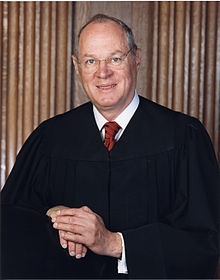
Everyone expects Justice Anthony Kennedy to be pivotal in deciding what will happen in these two cases.

Here’s what I wrote on February 8, 2012:

After yesterday’s ruling from the U.S. Ninth Circuit Court of Appeals, Prop 8 supporters jeered, and Prop 8 opponents cheered.  The news showed jubilant same-sex marriage supporters celebrating the ruling and resolute traditional marriage supporters vowing to appeal.

In the May 2009 California Supreme Court ruling in Strauss v. Horton, the result was the opposite, with Prop 8 upheld.  The August 2010 U.S. District Court ruling in Perry v. Schwarzenegger struck down Prop 8.  Yesterday’s ruling by a three-judge panel of the U.S. Ninth Circuit Court of Appeals in Perry v. Brown upheld the District Court.  Prop 8 proponents have 90 days (well, technically, 89 as of this morning) to decide whether to appeal to an 11-judge en banc panel of the U.S. Ninth Circuit Court of Appeals or to appeal directly to the U.S. Supreme Court.

If there’s any lesson to be learned from all the court battles involving Prop 8, it’s that it doesn’t matter what a particular court rules, the side that wins hails the ruling as a historic victory in defense of the legal concepts they support while the side that loses vows to go to another court.  The only way this cycle ends is to take this to the highest court in the land: only the United States Supreme Court can decide this issue once and for all.

In all likelihood, U.S. Supreme Court Justices John Roberts, Antonin Scalia, Clarence Thomas, and Samuel Alito will vote to uphold Prop 8 while Justices Stephen Breyer, Ruth Bader Ginsburg, Sonia Sotomayor, and Elena Kagan will vote to strike down Prop 8.  This means that whether marriage means one man and one woman or whether it means two people of any sex in California and in America rests in the hands of one man: U.S. Supreme Court Justice Anthony Kennedy.

There’s a certain irony that Kennedy will be the key to this issue, since Prop 8 comes from California, and Kennedy is a native Californian who spent the majority of his life in this state and was appointed to the Supreme Court by fellow Californian Ronald Reagan.  A Catholic educated at Stanford University and Harvard Law School, Kennedy was a lawyer in private practice and has been a law professor at McGeorge School of Law during his time as a lawyer and continuing to the present day.

Kennedy’s judicial track record does not make it clear how he’d come down on this issue.

In Beller v. Middendorf (1980), Kennedy (a Ninth Circuit Court of Appeals Judge back then) wrote the decision that upheld the ability of the U.S. Navy to discharge sailors for “engaging in homosexual acts.”  In Hurley v. Irish-American Gay, Lesbian & Bisexual Group of Boston (1995), he joined a unanimous Supreme Court opinion allowing the St. Patrick’s Day Parade to exclude an Irish gay group.

In Romer v. Evans (1996), Kennedy wrote the decision invalidating a Colorado ballot measure prohibiting sexual orientation from becoming a protected class (protected classes include race, religion, etc.).  In Boy Scouts of America v. Dale (2000), Kennedy voted to uphold the right of the Boy Scouts of America as a private organization to exclude gay men from being scoutmasters.

Both sides of the issue can find favorable parts of Lawrence v. Texas (2003), where Kennedy wrote, “the Texas [anti-sodomy] statute furthers no legitimate state interest which can justify its intrusion into the personal and private life of the individual” but also wrote that the case “does not involve whether the government must give formal recognition to any relationship that homosexual persons seek to enter.”  So Lawrence v. Texas tells us that Kennedy opposed attempts to regulate the conduct of consenting adults but also wanted to make clear that the decision did not affect marriage.

In Christian Legal Society v. Martinez (2010), Kennedy joined a court decision that allowed a public school to refuse recognition to a student group that wished to exclude gay members.

Kennedy’s dizzying array of court decisions leaves little clarity as to how he will rule.  However, there is little doubt that the fate of Proposition 8 and of the definition of marriage in California and America rests in the hands of one Californian above all others: Anthony Kennedy.

Of course, we mustn’t forget that Chief Justice John Roberts could somehow determine that traditional marriage, same-sex marriage, all forms of marriage, Prop 8, or DOMA is a tax, and comes up with a ruling that surprises everyone (see excerpt of June 28 post below), but then again there is the marriage penalty:

The second opinion of the day was the one everyone was waiting for: in a 5-4 decision in National Federation of Independent Businesses v. Sebelius, the U.S. Supreme Court upheld the entire health care law officially known as the Affordable Care Act but often called Obamacare.  The individual mandate was held unconstitutional under the Commerce Clause but was upheld under the power to tax.  The shocker: swing voter Anthony Kennedy was in the dissent.  It was conservative Chief Justice John Roberts who not only voted with the four liberal justices but who wrote the opinion.

Posted in California, National | Tagged: , , , , , , , , , , , , , , , , | Leave a Comment »

California’s Two Highest Paid State Employees Fired in Four-Month Span

Posted by Chris Nguyen on March 25, 2013

Making a combined salary of $5 million in 2011, California’s two highest paid state employees were cut from the state payroll in the last four months.

Hired in late 2001, the state’s highest paid state employee made $2.88 million in 2011.  He was fired in November after six years of subpar performance at UC Berkeley.

Hired in early 2003, the state’s second-highest paid state employee made $2.15 million in 2011.  He was fired over the weekend after five years of declining performance at UCLA.

Little surprise, all five of the top five highest-paid state employees (from 2011, the latest year with numbers available) came from the University of California system’s payroll.  With those two gone, the highest earners from 2011 still collecting state salaries are UCLA’s Ronald Busuttil ($1.98 million), UCSF’s Anthony Azakie ($1.81 million), and UCSF’s Philip Leboit ($1.53 million).

tedfordhowlandOh, those two who were fired?  The one fired in November was Jeff Tedford, Head Coach of the Cal Football, and the one fired over the weekend was Ben Howland, Head Coach of the UCLA Men’s Basketball team.

For some of our readers, you saw this a mile away as soon as you read the headline.  For other readers, this raised your hackles at the start of this post and is still an outrage.

Back in July, I had written a post about the massive $169 million subsidies that the UC and CSU systems provide to Division I athletic programs.  This is a net cost that already accounts for all revenues provided by these athletic programs to the universities.

UCLA spent $2.59 million in subsidies to its athletic programs while UC Berkeley spent more than four times as much, with $10.51 million in subsidies to its athletic programs.

As I noted in July:

At a time of budget cuts, tuition increases, class reductions, and enrollment reductions, should UC & CSU really be spending this much money to subsidize athletics?  Aren’t athletic departments supposed to subsidize the universities, not the other way around?

Posted in California | Tagged: , , , , , , , | 1 Comment »

Contrary to Popular Belief: Democrats Lack Supermajority in Legislature

Posted by Chris Nguyen on March 7, 2013

As of the November 2012 elections, Democrats had captured 29 of 40 State Senate seats and 55 of 80 State Assembly seats, giving them 2 seats beyond 2/3 in the Senate and 1 seat beyond 2/3 in the Assembly.

However, Democrats have had little chance to actually wield their 2/3 supermajorities because they have been plagued by vacancies.  In the Legislature, a vacancy is effectively a “no” vote, so if Republicans vote against a tax increase, an urgency measure, or any other measure requiring a 2/3 vote, the vacancy joins with Republicans in preventing the measure from reaching 2/3.

On January 2, State Senators Gloria Negrete McLeod (D-Chino) and Juan Vargas (D-San Diego) resigned to become Members of Congress, which shrunk the Democrats’ Senate supermajority to the bare minimum of 27.

Then on February 22, State Senator Michael Rubio (D-Shafter) resigned to take a job with Chevron, which cut the Senate Democrats down to 26 and putting them out of their supermajority.

Next week, the primary elections will take place to replace Senators Negrete McLeod and Vargas.  Assemblywoman Norma Torres (D-Pomona) is the leading contender to replace Negrete McLeod, though she has tough competition from San Bernardino County Auditor-Controller Larry Walker (D-Chino).  Assemblyman Ben Hueso (D-Encinitas) is the leading contender to replace Vargas.

If Torres or Hueso gets over 50% of the vote on Tuesday and resigns Wednesday morning, their seats could be filled as early as May 28 and as late as July 30.  If Torres or Hueso falls short of 50% on Tuesday, the run-off is not until May 14, and assuming they resign May 15, their seats could be filled as early as July 30 and as late as October 15.

The Democrats’ best case scenario has one (but not both) of Torres or Hueso breaking 50% on Tuesday, and the other going to a May 14 run-off.  This would put the Senate Democrats at exactly the magical number of 27  and the Assembly Democrats at exactly their magic number of 54 for a two-month window of mid-March through mid-May for their supermajorities.  If both break 50% on Tuesday or both get forced to a May run-off, Senate Democrats will rise back up to a supermajority with 28, but Assembly Democrats will lose their supermajority, falling back to 53, one short of a supermajority.

The Rubio vacancy can be filled as early as May 21 and as late as July 23.  Since Assemblyman Henry Perea (D-Fresno) has declined to run for the seat, no Assembly Democrat will fill the seat.

This past Tuesday, State Assemblyman Bob Blumenfield (D-Los Angeles) was elected to the LA City Council.  He will take office as a Councilman on July 1.  If he resigns from the Assembly July 1, his seat could be filled as early as September 10 and as late as November 29.

Also on Tuesday, State Senator Curren Price (D-Los Angeles) advanced to a May 14 run-off for LA City Council.  If he wins the run-off, Price will take office as a Councilman on July 1.  If he resigns from the Senate July 1, his seat could be filled as early as September 10 and as late as November 29.  Then, there’s the possibility if an Assemblymember seeks Price’s seat in the special election.

Note that any vacancies that occur in the final year of a term remain vacant under California law, so any Assembly vacancies (and any Senate vacancies in any of the 20 even-numbered districts) that occur after November 30, 2013, will remain vacant until the new term commences after the 2014 general election.

The Democrats’ supermajorities in the Legislature may be quite fleeting.

For Democrats, this will be quite frustrating because vacancies are impeding their ability to use their 2/3 power to implement the policies they’ve dreamed of for years.  For Republicans, this will be quite frustrating because it will be difficult to claim in the 2014 elections that Democrats have overreached and that voters want more Republicans to prevent the overreach; if the Democrats can’t wield 2/3, they can’t overreach.

(The timing on these special elections is that the Governor has two weeks from the vacancy to issue a proclamation for a special election, and the special run-off election must be 126-140 days after the proclamation; the special primary election must be held exactly 8 weeks before the special run-off election; the run-off is canceled if someone breaks 50% in the special primary.)

Posted in California | 2 Comments »

Jim Brulte Elected CRP Chairman

Posted by Chris Nguyen on March 3, 2013

In a surprise to no one, San Bernardino’s Jim Brulte has been elected CRP Chairman.

Here’s his official web site.

Here’s Brulte’s official business biography.

Here’s his Wikipedia biography.

Traditionally, CRP Vice Chairs become Chair.  As Vice Chair Steve Baric of Rancho Santa Margarita stepped aside for Brulte, Brulte proposed appointing Baric as Chairman of the Budget and Expenditures Committee.

Posted in California | Tagged: | 2 Comments »

San Francisco’s Harmeet Dhillon Elected CRP Vice Chair

Posted by Chris Nguyen on March 3, 2013

Harmeet Dhillon of San Francisco was elected State Vice Chair of the California Republican Party.

Here’s her official CRP campaign web site.

Here’s her law fim biography.

Here’s a profile piece on her from the San Francisco Chronicle.

Dillon won 881-227. In other words, she won with a landslide 79.5% of the vote.

Posted in California | Tagged: | 1 Comment »

Live from CRP: Officer Election Results

Posted by Chris Nguyen on March 3, 2013

I’m here at CRP, as are fellow OC Political bloggers Craig Alexander, Scott Carpenter, Chris Emami, Assemblyman Don Wagner, and Allen Wilson.

Tabulation is underway in the CRP Chairmanship election between San Bernardino’s Jim Brulte (who should win handily) and the San Gabriel Valley’s David Miller and in the CRP Vice Chair race between San Francisco’s Harmett Dhillon and Placerville’s Rodney Stanhope.  We’ll have more details on those races shortly.

In the meantime, here are some results:

  • Secretary: Former Orange Countian/Current Humboldt Countian Patricia Welch re-elected
  • Treasurer: Ventura’s Mike Osborn re-elected
  • Vice Chair – Central Coast: Greg Gandrud re-elected
  • Vice Chair – North: Arnold Zeiderman re-elected
  • Vice Chair – Los Angeles: Adam Abrahms re-elected
  • Vice Chair – Central Valley: Fresno’s Marcelino Valdez, Jr. defeated Sacramento’s Ruth Crone in a hotly-contested race.
  • Vice Chair – Northwest: Alyssa Watley
  • Vice Chair – Bay Area: Kevin Crick defeated Rohit Joy in a hotly-contested race.
  • County Chairmen’s Association President: Yolo County’s Mark Pruner re-elected

Update (11:50 AM):  RNC Committeeman and former CRP Chairman Shawn Steel advocates switching from semiannual conventions to biennial conventions to permit greater attendance (since the costs for delegates to travel will reduce from once every six months to once every two years).

Steel advocates switching from the present system of delegates being appointed by party nominees and party leaders to a system where delegates are elected by local Republicans.  He notes California has 1,500 delegates while Virginia has 15,000 delegates attending biennial VRP conventions.

Steel states people have expressed concern that it’d be difficult to control the party if delegates were elected locally instead of being appointed by party nominees and party leaders.  Steel notes isn’t that the point?  He argues the party should be controlled by locals in a bottom-up approach not controlled by party nominees/leadership in a top-down approach.

Posted in California | 3 Comments »

Two OC Legislators are the Leading Contenders for Assembly GOP Leader

Posted by Chris Nguyen on February 5, 2013

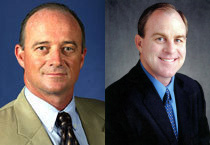
Don Wagner (R-Irvine) and Travis Allen (R-Huntington Beach)

Yesterday afternoon, the Sacramento Bee posted a story about the possible removal of Assembly Republican Leader Connie Conway (R-Visalia).

Conway led her caucus into the 2012 elections and into its smallest size since 1883.  (In a ray of hope, while Republicans held 19 seats in 1883, the GOP gained 41 additional seats to reach 60 seats in 1885, thereby flipping a 61-19 majority for Democrats into a 60-20 majority for Republicans in two years).

While Conway’s failings and probable removal were the main thrust of the story,  the more interesting information for our readership is that the two leading contenders in the story to replace Conway are both from Orange County.

Second-term Assemblyman Don Wagner of Irvine and first-term Assemblyman Travis Allen of Huntington Beach were cited as the two most likely contenders.

In the last 30 years, there have been 18 Assembly Republican Leaders, but only four have been from Orange County:

  • Ross Johnson (1988-1991)
  • Curt Pringle (1995-1996, 1996-1997; the interruption in Pringle’s tenure as Republican Leader is because he was Speaker in 1996)
  • Scott Baugh (1999-2000)
  • Bill Campbell (2000-2001)

In the same time span, there have been 10 Senate Republican Leaders, and three have been from Orange County (and four have represented Orange County):

  • Rob Hurtt (1995-1998)
  • Ross Johnson (1998-2000)
  • Dick Ackerman (2004-2008)
  • Bob Huff (2012-present) – Huff is not from Orange County but represents substantial portions of OC

First elected in 2010, Wagner terms out in 2016.  First elected in 2012, Allen terms out in 2024.  (In both cases, I’m assuming that they are both re-elected the maximum number of terms allowed and serve those terms consecutively.)

In either case, Wagner or Allen would be the first Assembly Republican Leader from Orange County in a dozen years.

The next Assembly Republican Leader has exactly two priorities: protecting seats currently held by Republicans and winning seats occupied by Democrats.  The top three seats the leader needs to protect are Jeff Gorell‘s Ventura County seat, Mike Morrell‘s San Bernardino County seat, and freshman Eric Linder‘s western Riverside County seat.  Target #1 is the Antelope Valley seat held by freshman Steve Fox (D).  Target #2 will be in the leader’s backyard (assuming Wagner or Allen is the next leader) with the North Orange County seat occupied by freshman Sharon Quirk-Silva (D).

Failure to preserve the existing seats 25 seats and failure to gain either of those target seats will result in the next leader going the way of Conway, and let’s not forget Conway became Republican Leader when Martin Garrick stepped down after losing a Republican seat in 2010.

Posted in 68th Assembly District, 72nd Assembly District | Tagged: , , , , , , , , , , , , , | 6 Comments »