At the age of 57 I have accomplished a series of large goals. I have enjoyed the private sector for more than eighteen years and served as a managing partner of a wonderful Certified Public Accounting firm office for ten of those years. I served as an elected County Treasurer-Tax Collector for twelve years, turning around a department that had been an international embarrassment. I am now concluding eight years as a County Supervisor, which provides an incredible breadth of exposure to services provided by the state and Federal governments to the local level. In between, I have visited all 58 counties of the state of California with my wife and three children, photographing nearly all of the 1,100 California State Historical Landmarks. I have hiked to the peaks of every mountain range you can see here in the immediate area and traversed throughout the Sierras, including summiting Mt. Whitney a couple of times. I served on the California Sesquicentennial efforts with Huell Howser and other wonderful historians, finding myself again traveling all around the state (on my own dime) in this attempt to commemorate California’s 150th anniversary as a state. Most importantly, I have a story. My political career started because I stepped into the forum to decry the irresponsible investing practices of Robert L. Citron with taxpayer dollars. The rest is history and is well documented in a long list of books and publications, including my LOOK BACKS. Having been through a Chapter 9 bankruptcy turnaround, I know the drill. I have been publicly outspoken on municipal fiscal and investment management for some twenty years or more. As you can see from the last LOOK BACK below, I have been addressing the public employee defined benefit pension plan crisis for more than ten years! I love California, I love it’s history, and I would love to participate in turning its dismal financial condition around.
With this collective forty years of post-high school experiences, and the encouragement from many friends and supporters, the idea of considering a Big Hairy Audacious Goal is in front of me. It’s fun to ponder an idea that was never on my radar screen when my journey began. With that, NBCNews.com picked up the OC Register’s electronic article on my current decision process. I’m just laying things out for you as it relates to this very recent consideration of a Big Hairy Audacious Goal. I’m not campaigning or asking you to do anything at this time. Just know that I am on a listening tour on what may be my Plan A, Plan B, Plan C, or Plan D. Proverbs 11:14 states that “in the multitude of counselors there is safety.” Accordingly, I’m calling as many individuals as time permits to ask for their counsel. It is nice to have options. It is great to have friends. It is amazingly wonderful to have a supportive wife and three great adult children (and son-in-law). Having a new granddaughter certainly provides the necessary perspective on life in general. My family has allowed me to risk and sacrifice in the past and they continue to allow me to dream big dreams. And for that I will be eternally grateful. In the meantime, I am fully focused on my current position, which commands more than 100 percent of my attention.

Santa Ana, CA on

Supervisor Moorlach exploring run for governor
The Republican says he’s ‘calling some key people’ and having fun, but is ‘very realistic’ about his chances.
By ANDREW GALVIN
County Supervisor John Moorlach confirmed this week that he considering a run for governor in 2014.
Moorlach, a Republican who was the county’s elected treasurer-tax collector for 12 years before winning election to the Board of Supervisors in 2006, stressed he hasn’t decided whether to run for governor but has been “calling some key people here and in Sacramento” and so far, “no one’s telling me ‘no.'”
Moorlach will be termed out from his Board of Supervisors seat next year. Last year,Moorlach failed to persuade his board colleagues to seek voter approval of a measure that would have extended the term limit for supervisors from two consecutive four-year terms to three. Moorlach had hoped to run for a third term in 2014, saying the complexity of the job made experience valuable.
With that possibility gone, Moorlach said he gets a lot of people asking “What are you doing next?” Some suggested he run for governor, which he said he laughed off at first. But after hearing it for “the umpteenth time, and it’s getting past joking, then why don’t you go ahead and look at it?” he said Thursday.
“I’m just exploring and listening and asking questions and actually having a lot of fun,” he said.
Moorlach describes himself as “very realistic” about the chances of any Republican candidate in a state where Democrats hold a big advantage in voter registrations.
“We all know if (Gov.) Jerry Brown re-runs it’s going to be a very difficult thing to do,” he said. “But it seems Jerry would be fun to debate in that case in the fall of 2014.”
Tim Donnelly, a Republican assemblyman from San Bernardino County, also has said he’s exploring a run for governor. Moorlach met briefly with Donnelly during a recent working visit to Sacramento and shared that he, too, is considering a run.
In November, after Donnelly said he was forming an exploratory committee to run for governor, the Lincoln Club of Orange County, an influential Republican group, issued a statement denouncing Donnelly’s views on immigration. Donnelly, a former Minuteman Project leader with Tea Party ties, tried unsuccessfully to qualify a ballot measure to repeal the California Dream Act, which allows undocumented immigrants to get state-funded college aid.
“We cannot support Republicans who continually target immigrants, who are members of our community, as scapegoats for their own political advantage,” said the statement by Robert Loewen, the Lincoln Club’s president.
Moorlach, who emigrated as a child with his parents from the Netherlands to Orange County, said it’s not time yet to discuss his views on issues such as immigration, as that would imply he’s made up his mind to run. However, he said, “I prefer some of the proposals that have been proffered by the Lincoln Club and Sen. Marco Rubio.”
Last year, the Lincoln Club adopted a policy statement on immigration reform that would allow undocumented immigrants to transition to guest-worker status and a pathway to legal residency, not citizenship.
Moorlach said it will be a month or two before he makes up his mind whether to run for governor. If he does decide to go for it, the next step would be to form a campaign committee and “try to raise some significant dollars.”
The blog OC Political earlier this week reported on speculation that Moorlach was looking at a run for governor.
Separately, the Board of Supervisors has narrowed its search for a new county executive officer. The CEO is the highest non-elected post in county government, overseeing 17,000 employees.
After Voice of OC reported this week, citing unidentified sources, that the supervisors were in negotiations with Santa Barbara County CEO Chandra Waller for the job, Waller notified her bosses on Santa Barbara’s Board of Supervisors that she was indeed in discussions with Orange County.
Orange County’s last CEO, Tom Mauk, resigned in August over his handling of sexual-abuse allegations against former OC Public Works executive Carlos Bustamante.
Bustamante has pleaded not guilty to 12 felony counts. A preliminary hearing in his case is scheduled for April.
Contact the writer: agalvin@ocregister.com
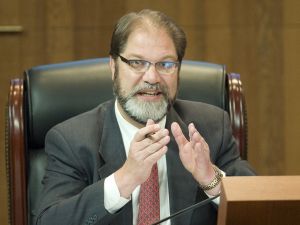
County Supervisor John Moorlach, pictured here in a January meeting, says he is considering seeking the Republican nomination for governor in 2014.
PAUL BERSEBACH, ORANGE COUNTY REGISTER
FIVE-YEAR LOOK BACKS
February 21
2008
Less than a month after being reassured by PFM Asset Management of San Francisco that the Treasurer’s investment portfolio was fine (see MOORLACH UPDATE — OC Register — January 29, 2013), and that my concerns may have been unwarranted, contradictory news is received. Christian Berthelsen of the LA Times covers it in “O.C. investments lose market value as fund nears default – The investment in England-based Whistlejacket is a small portion of Orange County’s overall portfolio, but the once-bankrupt county remains gun-shy about financial risk.” For more than thirteen years Merrill Lynch was the broker dealer scorned by the County. Add to the list one Standard Chartered Plc. of London, England, for fiscal imprudence and inflicting losses based on greed and unprofessionalism. Five years later and I still have a visceral reaction when I hear the name of Standard Chartered.
Orange County’s latest investments in complex financial deals took a turn for the worse Wednesday when a fund in which the county placed $80 million neared default after a major U.K. bank aborted plans for a bailout.
County officials said they expect the fund to miss a principal and interest payment to another investor today.
That, in turn, would drive down the market value of Orange County’s holdings.
County treasury officials said they were in the process of writing down the value of the holdings but did not yet know by how much.
Still, they said they would hang onto the notes in the belief they will ultimately recover the county’s investment in full, rather than lose money in a fire sale.
The fund, a $7.15-billion structured investment vehicle named Whistlejacket and backed by London-based Standard Chartered Plc., was forced into receivership last week and had its credit rating slashed.
The O.C. treasurer’s office sent a memo to county officials Wednesday assuring them it would be able to meet the near-term cash needs of investors in the county portfolio, noting the troubled investments are held in a longer-term fund.
The treasury invests the cash balances of the county and many local school districts.
The investment in Whistlejacket is a small portion of Orange County’s overall $7-billion portfolio. But the county is still feeling the effects of its 1994 bankruptcy and remains gun-shy about financial risk.
The county has invested nearly $850 million in structured investment vehicles, or 14% of its portfolio.
Officials have been nervously watching since Treasurer Chriss Street disclosed in December that $460 million of the county’s holdings in such investments faced a potential credit rating downgrade.
In December, as concern grew about the structured investment vehicles and Street fought off an effort to strip him of investment powers, the treasurer assured board members and the public that the county’s SIV holdings were “safe, strong and sturdy.”
Asked if he stood by those comments Wednesday, Street said: “I made those comments based on the information available at the time.
“The markets are very fluid and there is unprecedented turmoil in the credit markets.”
Standard Chartered said Whistlejacket’s finances had been hurt by the tightening credit markets, limiting its ability to issue short-term debt. In a Jan. 31 statement, the bank said it was working on a cash infusion to shore up Whistlejacket’s liquidity, but last week it was forced into receivership as the market value of the fund’s assets continued to decline.
On Wednesday the bank issued another statement saying it was “disappointed” that it was unable to complete a bailout, citing the difficulty of doing so under receivership.
Deloitte & Touche, the consulting and accounting giant appointed to oversee Whistlejacket’s receivership, told investors earlier this week that it would temporarily suspend interest and principal payments while it sorts out the fund’s finances. Whistlejacket failed to make a payment due Feb. 15. It will fall into default today if it does not make the payment.
Street said he was surprised by Standard’s decision to abandon the bailout effort, because other banks have stepped in to shore up their SIVs, and he said that as recently as Monday he was told the rescue was in the works. He stood by the decision to hold the investments and said he is seeking a seat on Whistlejacket’s creditors’ committee.
“Quite frankly, I’m starting to feel that Standard Chartered actively misled investors,” he said.
None of the county’s other SIV holdings have been downgraded. One, in which the county invested $50 million, is scheduled to come to maturity today, and officials said they expect to receive the payment with no problems.
Orange County purchased two medium-term notes in Whistlejacket in January and July 2007 totaling $80 million, both of which mature in January 2009. The county has received $2.2 million in interest payments thus far, and was scheduled to receive another $3.3 million in interest payments beginning in April.
Supervisor John Moorlach, the former county treasurer who is now chairman of the Orange County Board of Supervisors, said there was little the county could do at the moment other than monitor the situation. “All we can do at this point is wait for further updates,” he said. “I’m certainly not inclined to sell it at a major discount.”
Brianna Bailey of the Daily Pilot provided the details of one action I was taking to address the Standard Chartered crisis. It was mentioned in her “The Political Landscape” column,“O.C. reaches out to U.K.” Regretfully, our friends on the other side of the pond were unable to provide much assistance. They did assist in a telephone conference with Chartered Standard, where they clearly stated they were happy to have the OC take the loss as they were not interested in taking it themselves.
The troubled state of one of the county’s investments prompted Orange County Board of Supervisors Chairman John Moorlach to contact the British Consulate after he met Prince Andrew last week at a local luncheon.
Orange County has $80 million invested in the United Kingdom Channel Islands-based Whistlejacket Capital Ltd.
Whistlejacket is a structured investment vehicle that could default this week after the fund failed to repay maturing debt, according to Standard & Poor’s. The fund’s U.K. roots prompted Moorlach to call his new British friends this week and ask, “Hey, can you help us out,” he said.
Moorlach is unsure what the consulate could do, but he said it couldn’t hurt to ask.
“This could become an international concern,” Moorlach said.
The chairman met Prince Andrew when the two were seated together during a luncheon at the Orange County Hilton last week. The prince visited Costa Mesa to strengthen business ties between the U.K. and Orange County.
Structured investment vehicles are used to purchase assets through short-term borrowing. Whistlejacket would be the sixth SIV to fail to repay its debt in recent months, according to Bloomberg Business News.
Moorlach said Wednesday the fund’s underlying assets had deteriorated to such a level the county would probably try to salvage as much as it could of its principal investment.
“Getting anything less than 100% back is probably going to have an impact in the county,” he said.
Ron Campbell of the OC Register covered the story in “Company in which O.C. has invested $80 million faces default – Treasurer says county should recover full investment in British company.” Here are the closing paragraphs:
Orange County owns two Whistlejacket SIVs, a $30 million issue purchased in January 2007, and maturing on Jan. 25, 2009, and a $50 million issue purchased last July and maturing on Jan. 26, 2009.
Supervisor John Moorlach, Street’s predecessor as treasurer and now his leading critic, said he was anxious about Whistlejacket.
“Now the question is, if we hold on until January are we going to get 100 percent of our principal? 99 (percent)? 95 (percent)?” Moorlach asked.
SIVs hold baskets of assets such as mortgages, credit card debts and student loans.
Institutional investors such as Orange County provide capital to buy assets. They are promised their money back with interest in two to three years and are supposed to be paid back before anyone else.
SIVs typically leverage their initial assets by several times to buy more assets. They finance this with a series of two- to three-month loans.
But the worldwide credit crunch, which began last summer with the collapse of the Orange County subprime lending industry, has nearly dried up the loan market for SIVs.
The county began investing in SIVs at least seven years ago underthen-Treasurer Moorlach. Street nearly tripled the county’s SIV portfolio after taking office in December 2006.
Currently the county holds $837 million in SIVs. Together they comprise about 14 percent of the county’s $6 billion investment pool.
One $50 million issue by Sigma Finance matures Thursday. Street said he expects Sigma to pay in full on time. About half the remaining SIVs mature later this year and the rest in stages through September 2009.
Daily Pilot “The Bell Curve” columnist Joseph N. Bell, promoted my upcoming speaking event with the Airport Working Group (AWG), with his piece “Time to speak up about JWA.” I am providing his column in full. As a gentle reminder, the JWA “improvements” were a remodeling, not an expansion, to handle the current capacity that had been agreed to. I have enjoyed my collaboration with AWG over these past six years and aim to continue our great working relationship.
Two weeks ago, Newport Beach Mayor Ed Selich told a Speak-Up Newport audience about the goals he sees as priorities in his new job as the city’s chief executive.
The following week, Newport Beach City Manager Homer Bludau sent a newsletter to all local citizens describing the projects that will receive the attention of city officials in the immediate months ahead.
These two events had one striking element in common.
Neither stressed the urgent need by the city and its residents to address the actions, already underway, that set the stage for expanding John Wayne Airport.
This is rather like the city officials of New Orleans debating which streets to repair while a hurricane is just offshore.
If you think this parallel is excessive, come and sit in my patio some morning and late afternoon.
Then multiply what you hear by the number of new gates and added passengers already agreed on under the current caps. Then introduce the “x” factor, the pressure that is certain to be brought to bear to trash the caps on flights and passengers that will expire in 2015.
If you’re one of the people under the JWA flight pattern who is tearing down an old home to build a new one or adding new rooms to old ones or just sitting on a patio like mine trying to talk and be heard over the roar of engines, you should be very uneasy. New and drastic threats to the magnificently evolved atmosphere in which we live are underway right now with little or no awareness among those of us who will be most affected.
For example, under the Airport Improvement Program, almost $600 million will be spent to expand John Wayne Airport. This expansion — which is euphemistically called “improvement” — will include a new multi-level terminal of 250,000 square feet, six new bridged aircraft gates and two new parking structures with some 3,500 spaces.
Design work for the new terminal and parking structures is already underway, along with preliminary construction work. Completion is estimated for 2011, four years before the current cap on JWA flights expires.
These numbers are signposts that point directly to the eventual downgrading of our neighborhoods, our Back Bay and beaches, and our quality of life. They need to be recognized and dealt with now. That can only happen with a sense of urgency that requires holding the line at JWA to dominate any set of goals for this community.
Such urgency is hard to find in Newport-Mesa these days. True, the Airport Working Group is fighting the good fight, as it has for several decades.
The members of Air Fare have planted their flag on no further concessions. The City Council calls it a priority to “minimize the adverse impacts of John Wayne Airport through the implementation of the city’s airport policy.”
But all of this has an air of business as usual, the sort of attitude that allowed the commercial airport at El Toro to slip away from us. Joint meetings are held on a quarterly basis. Meetings of corridor cities take place every other month to “explore mechanisms for formalizing the coalition.”
Consultants with “technical expertise” are sought. Partnership with Costa Mesa is exploring transportation to other airports. Business as usual.
I asked Selich why limiting airport expansion didn’t dominate the list of goals in his speech, and he said he could hardly cover it all in a 15-minute speech and so he chose to “focus on development issues” with the implied understanding from his audience that there was, indeed, an unspoken sense of urgency about JWA.
“We’ve got a cap right now,” he said. “We’ve got to build on that. It’s too early to start negotiating a new settlement.”
It isn’t too early. It may even be too late. Go take a look at the construction sites for the new and better JWA.
It’s time for the residents of this community who have their quality of life on the line to get involved. To impress on the business as usual proponents — from the county supervisors on down to local officials and including this newspaper — that the time has come to rev it up several notches. To put to use some of the muscle that comes with public outrage. And, for starters, to attend the Feb. 26 annual meeting of the Airport Working Group.
Orange County Supervisor John Moorlach will be the featured speaker at that meeting. He’ll provide plenty of ammunition for marching orders to those who attend.
His intent, as well as that of the AWG, is to put the information out straight and clear. The rest is up to us to flex the muscle. Our greatest enemy is complacency, which had a lot to do with getting us into this fix.
The people who would destroy our environment by nibbling us to death with gradually increasing caps won’t negotiate with us unless we keep their feet to the fire. So let’s do it. And for starters, don’t forget that AWG meeting from 6 to 8 p.m. Feb. 26 at the Balboa Yacht Club, 1801 Bayside Drive, Newport Beach.
February 22
2008
The first domino was about to fall and J. M. Brown and Sarah Rohrs of the San Jose Mercury News provided the news in “Vallejo bankruptcy could have far-reaching impact.” Because it portended what would eventually occur, I’m providing the piece in full.
If Vallejo becomes one of the first California cities to file for bankruptcy, the negative effects could be far-reaching, but also may leave the city with a fresh start, experts said Thursday.
If it takes this route, Vallejo would still need to keep its doors open and provide municipal services, though employees may be asked to stay home if there’s nothing in the coffers to pay them.
“The city would still be there and would still have to provide services for residents. With the city you can’t just disappear,” said Orange County Supervisor John M.W. Moorlach, an expert on bankruptcy since his own county took this route in 1994.
Through Chapter 9 protection, a federal bankruptcy judge would sort through the city’s finances, labor and other contracts, and then work out a fiscal plan to move forward.
The situation is different than that of the Vallejo City Unified School District which plunged into a deep fiscal hole in 2004, and secured a $60 million state bail-out loan.
City officials have warned that declaring bankruptcy will not print money, or generate any revenues.
Vallejo’s potential bankruptcy would not be California’s first municipality filing for Chapter 9 bankruptcy.
Orange County filed for bankruptcy in 1994 after a series of bad investments. And Desert Hot Springs, a town of 20,000, sought Chapter 9 protection several years ago after a crushing court judgment on an environmental matter, said Marc Levinson, Vallejo’s bankruptcy attorney.
Experts say Vallejo’s case undoubtedly will raise speculation about municipal bonds that cities use to fund facility improvements and other activities because the once-certain guarantee of profitability will suddenly look poisonous to investors.
Bankruptcy is certain to spark fresh debate about the cost of unfunded employee benefits, and the impacts on bond holders.
As of December, the city had accrued a $135 million liability for the present value of retiree benefits earned by active and retired employees earned. Further, there is a $6 million added cost as current employees continue to vest and earn future benefits, the city said.
“If bond holders are hurt by a bankruptcy, then future lenders will probably put constraints on elected officials’ ability to make promises while in office that must be paid after they leave,” said CPA Marcia Fritz, vice president and treasurer for California Foundation for Fiscal Responsibility, which advocates for pension reform.
“It’s almost a relief that it’s finally coming to this in Vallejo because it will be an example of what happens when you’ve got a lot of people with their fingers in the cookie jar,” she said. “I saw this coming years ago.”
While some experts argue that bankruptcy can leave a city in better financial shape, others argue that it will hurt Vallejo’s future credit rating and place the city’s future in the hands of a federal bankruptcy judge.
The Vallejo school district is nervously keeping an eye on the city’s fiscal emergency. District spokesman Jason Hodge said the crisis might cause the city to withdraw funding for campus police officers, and after-school programs.
The Chapter 9 process, which Vallejo has budgeted $1 million to pursue, could last for years until repayment plans are OK’d.
Experts agree one thing is certain. If the city cannot pay its employees because the general fund is dry — which is predicted to happen by April — City Manager Joe Tanner must instruct all employees to stay home.
“They can’t come to work,” said Levinson, Vallejo’s bankruptcy attorney. “You can’t ask for credit or to extend your credit if you know you can’t repay the debt. It’s not only common sense, it’s the law.”
Alan Davis, attorney for the police and fire unions whose leaders are negotiating with the city to erase an immediate $10 million shortfall, declined comment. The unions represent employees whose salaries total 80 percent of Vallejo’s general fund.
The unions argue they have deferred salary increases and benefits for years while the city has failed to raise enough money to pay them.
For nearly two years, city and union officials have been haggling behind closed doors — then in arbitration — over cuts in salary and disputed staffing levels.
Nearly two-dozen police and firefighters retired last week or are expected to retire in coming days at a cost of at least $4 million in accrued sick and vacation time. The city is locked into contracts with the unions for two more years.
“Once granted, collectively bargained retirement promises can’t be reversed, no matter how outrageous, and no matter how much citizens scream when they find out,” Fritz said. “Bankruptcy may be the only way for Vallejo to legally break these promises and get control of its finances.”
City bankruptcy attorney Levinson said he would rather see Vallejo reach compromises with the unions than file bankruptcy. That’s a decision the City Council could consider Tuesday when it weighs an emergency fiscal plan calling for citywide layoffs.
Interim Fire Chief Russ Sherman agrees, saying, “It’s a nightmare situation — something that everyone has worked long and hard to try to prevent. I’m still holding out optimism that we can get to some sort of agreement to avoid bankruptcy because there would be no winners.”
But Arthur J. Spector, the former chief bankruptcy judge of the U.S. District Court, Eastern District of Michigan, said bankruptcy may indeed make winners out of those who seek it.
In an interview Thursday, Spector, now a bankruptcy attorney in Florida, said any entity having a hard time getting credit because of crushing debt will only have a harder time the longer it waits to receive protection from creditors. Bankruptcy may eventually lead to a fresh, or at least fresher, start, he said.
“If you can’t can you get credit today, tell me how bankruptcy would hurt your credit?” he said.
Orange County Supervisor Moorlach said Vallejo’s problem is that it’s spending more than it’s taken in each year, and it’s “creating obligations it never could afford and never should have made.”
Vallejo’s situation could be a forecast of what faces other municipalities which have agreed to “unsustainable employee and pension agreements,” he added.
While rare, other cities and municipal districts nationwide have felt similar pressures of dropping revenues and increasing expenses enough to file for bankruptcy or publicly consider it, like New York City.
Bridgeport, Conn., a city of 140,000, shocked the investment world in 1991 when it filed for Chapter 9 protection due to a $17 million deficit on its $300 million budget. Bridgeport faced $220 million in general obligation debt.
Based on Chapter 9 provisions, a city’s creditor separates into committees of unsecured creditors, like employees and contract services, and secured creditors with collateral-based debt, like bondholders. The city would then work to reach payment plans.
“Unsecured creditors don’t have to be paid,” Fritz said. “Anyone doing business with the city of Vallejo, like the garbage company, will be the first to get hit. Payments due them are not going to be paid right away.”
A judge would rule on any payment agreements based on a city’s financial ability and other factors, then oversee litigation if a city can’t reach a deal with creditors. But a judge won’t typically scour a city’s books to see if it could draw money that it isn’t already.
“A judge won’t throw out creative solutions,” Levinson said. “It’s really up to the players to come up with the deal. You continue to try to achieve peace rather than going to war. War is expensive.”
As the city works out deals, investment specialists are going to have a harder time selling municipal bonds, especially in California due to the state’s $14 billion budget shortfall.
“Outside investors are getting spooked by our fiscal imbalance,” Fritz said. “Once the city goes down in Vallejo, you’re going to see bond prices dropping like flies. A whole specter of bonds will get hit by one bad apple — it happens all the time on Wall Street.”


 As of the November 2012 elections, Democrats had captured 29 of 40 State Senate seats and 55 of 80 State Assembly seats, giving them 2 seats beyond 2/3 in the Senate and 1 seat beyond 2/3 in the Assembly.
 In a surprise to no one, San Bernardino’s Jim Brulte has been elected CRP Chairman.
 Harmeet Dhillon of San Francisco was elected State Vice Chair of the California Republican Party.


 OC Political